Politics has always involved a certain amount of theater, but sometimes the actors forget their lines so badly that the entire production collapses. That is exactly what happened during a recent high-profile Senate hearing featuring former Justice Department special prosecutor Jack Smith.
Republicans wanted a dramatic takedown. They got a viral embarrassment instead.
If you have been following the fallout from the Trump-era prosecutions, you know the stakes are high. Lawmakers eager to signal loyalty to Donald Trump have made it their mission to scrutinize every move made by the prosecutors who brought charges against him. But when Senator Eric Schmitt of Missouri took aim at Smith during a congressional inquiry, his preparation fell apart in real time.
The Setup That Went Wrong
Schmitt arrived armed with visual aids, a narrative, and supreme confidence. His goal was to link Jack Smith to Fani Willis, the former Fulton County district attorney who prosecuted Trump in Georgia. The timeline of Willis's personal entanglement with special prosecutor Nathan Wade had already caused massive disruptions in that case. Schmitt wanted to weave Smith into that same web of alleged corruption.
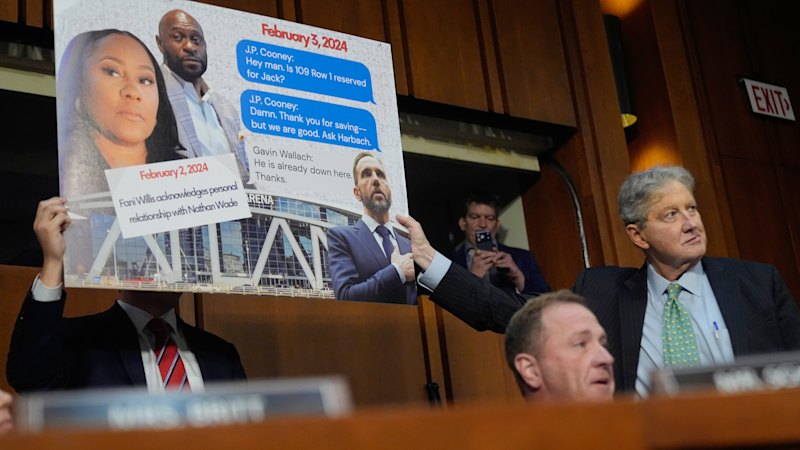
The senator brought out a large cardboard poster covered in text messages. He claimed these documents proved Smith was in Atlanta, Georgia, on February 3, 2024—the exact weekend the Willis-Wade scandal exploded into public view. Schmitt implied collusion, leaning heavily into the kind of gotcha politics that plays well on right-wing media networks.
Smith looked bewildered. He denied being in Atlanta that weekend and denied ever meeting Willis or Wade. Schmitt doubled down, accusing Smith of perjury on the spot. Staff members proudly hoisted the poster for the cameras.
Confusing Pro Basketball with College Hoops
The entire narrative imploded the moment Smith actually read the text messages on the poster.
It turned out that the basketball game in question did not feature the NBA's Atlanta Hawks. It featured the University of Iowa Hawkeyes. And the venue was not in Georgia—it was at the University of Maryland, where Caitlin Clark and her teammates were playing.
Schmitt had apparently confused the Atlanta Hawks with the Iowa Hawkeyes, treating two entirely different basketball leagues and geographic locations as interchangeable proof of a conspiracy.
Democratic Senator Amy Klobuchar jumped in to call out the blunder, noting that hurling serious accusations like perjury without checking basic facts is reckless. Progressive media outlets quickly dug up footage confirming Smith was indeed in Maryland watching college basketball, not plotting in Atlanta.
The Double Down
In a normal political environment, a mistake of this magnitude triggers a quiet retraction or an awkward dodge. But modern political media operates on a different set of incentives.
Hours after the hearing, Schmitt appeared on pro-Trump digital shows, where hosts praised his performance without acknowledging the factual error. When cornered by reporters on the street, the senator refused to back down, claiming he would just take Smith at his word while leaving the original accusation hanging in the air.
This refusal to correct course points to a broader problem in Washington. Speed and noise routinely outweigh accuracy. Lawmakers want viral clips for social media feeds more than they want genuine oversight. When your primary metric of success is how many retweets a 30-second video gets, checking whether the Atlanta Hawks and the Iowa Hawkeyes are the same thing feels like an unnecessary chore.
Jack Smith stood by his work, stating firmly that his investigations were grounded in evidence and that he would make the exact same decisions again. Meanwhile, the hearing will be remembered less as a serious inquiry into prosecutorial overreach and more as a masterclass in clumsy political theater.