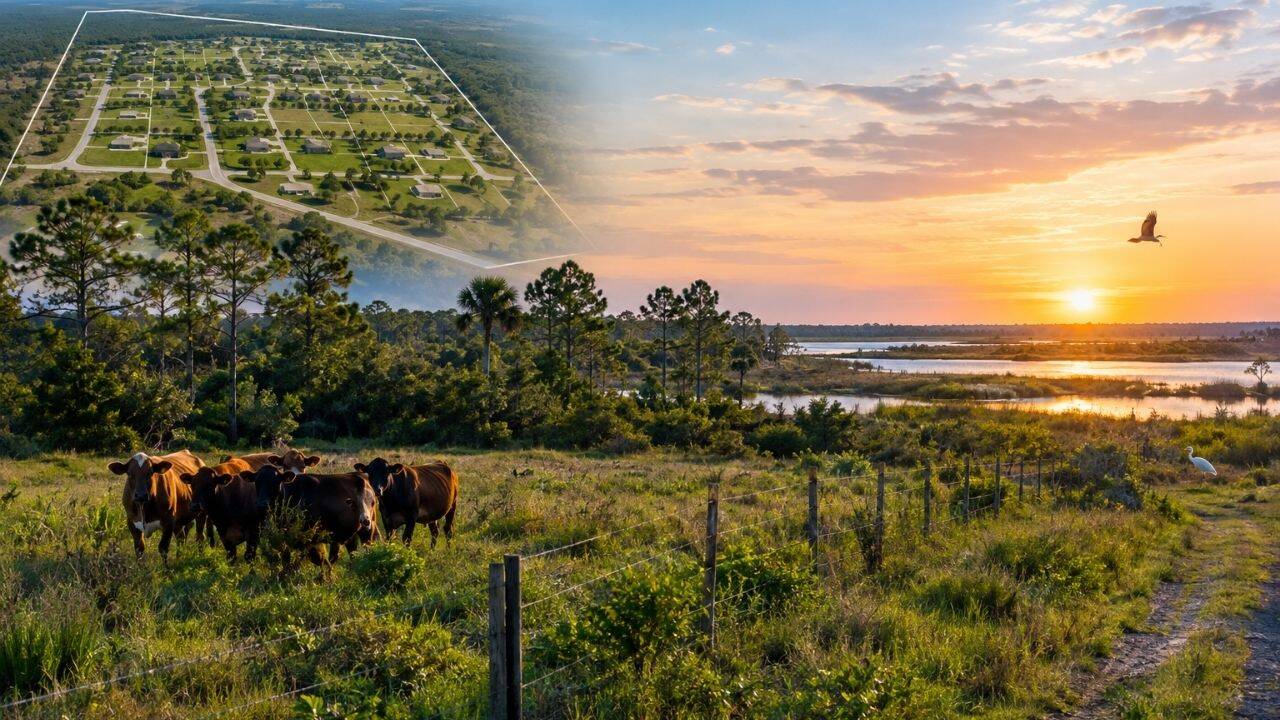
When a landowner draws up plans to chop a sprawling cattle ranch into dozens of residential parcels, local governments usually look the other way until the concrete trucks roll in. But in eastern Collier County, Florida, the local government played a different hand. After two grueling years of appraisals, counter-offers, and intense negotiations, county commissioners agreed to shell out roughly $7.8 million to purchase the 625-acre Wildflowerz Ranch.
The goal? Stop a 52-lot residential subdivision dead in its tracks and turn the property into permanent conservation land.
If you've watched Florida's interior get swallowed by suburban sprawl over the past two decades, you know deals like this don't happen by accident. They happen because local preservation programs have actual teeth and landowners realize that holding out for a development payday isn't their only viable exit strategy.
The Battle Over Oil Well Road
Wildflowerz Ranch sits right along Oil Well Road, east of State Road 29, in a part of Florida that still feels wild compared to the coast. Historically, the property operated strictly as a working cattle ranch, complete with fencing, pens, a pole barn, and shooting berms. But economics change. Faced with rising property pressures, the owner mapped out a blueprint to divide the 625 acres into 52 ranchettes, each spanning roughly 10 acres.
Real estate listings even started marketing those 10.1-acre lots with asking prices hovering between $289,000 and $479,000.
That development threat wasn't a bluff. At a September 22 public hearing, attorney Rich Yovanovich made the owner's stance crystal clear to the Board of County Commissioners: the preference was to sell the property to Conservation Collier, but if the county dragged its feet, bulldozers and subdivision plats would take priority.
Faced with losing a massive ecological corridor to rural sprawl, the county took the bait—or rather, took the opportunity.
Crunching the Numbers on Conservation Collier
Buying land for preservation isn't as simple as writing a check. It involves bureaucratic gymnastics, competing appraisals, and strict county purchasing formulas.
Collier County's initial screening report scored Wildflowerz Ranch an impressive 331 out of 400 points under the Conservation Collier assessment framework. That high score reflects the property's genuine ecological worth. It sits squarely within the Big Cypress Area of Critical State Concern and the Rural Land Stewardship Area Overlay. Worse yet for developers, but great for wildlife, the land overlaps with the Okaloacoochee Slough—a massive 32,000-acre freshwater wetland system spanning both Collier and Hendry counties.
Yet, agreeing on a price took nearly 24 months of sparring:
- September 2024: The county initially offered $6,700,500 based on the acquisition rules at the time.
- December 2025: Two independent appraisals valued the land much higher, landing at $7.03 million and $7.99 million.
- January 2026: The county tried to stick to its policy of using the lower appraisal, offering $7.03 million. The owner promptly rejected it and countered at $12.8 million.
Instead of walking away, commissioners compromised. They eventually agreed on a revised purchase price of $7,813,564.70. This adjustment happened after the owner agreed to carve out about 14 acres to convey to the Lee County Electric Cooperative. Commissioners leaned toward the higher end of the appraisal spectrum because the environmental stakes were simply too high to let slip away.
Why This Land Matters to Florida Ecosystems
You might wonder why local taxpayers should fund a nearly $8-million land purchase just to keep cows grazing. The answer lies in what lives underneath and flies above those pine flatwoods.
The Conservation Collier screening report documented freshwater marshes, scrubby flatwoods, and mixed wetland hardwoods across the ranch. These habitats support vulnerable species like wading birds, crested caracara, gopher tortoises, Big Cypress fox squirrels, and bonneted bats. Wildlife telemetry tracking has also routinely logged endangered Florida panthers roaming through the surrounding region.
Allowing 52 homesites to pop up across 10-acre tracts would have fragmented the habitat. Fences, domestic pets, septic tanks, and paved driveways carve up continuous wilderness, choking off wildlife corridors that animals rely on to migrate and breed.
The Cattle Stay Put for Now
Conservation victories don't always mean turning land into a locked-down park overnight. In this case, commissioners made a pragmatic choice to keep the agricultural engine running.
Alongside approving the purchase, the board extended the existing cattle lease on the property through December 31, 2027. The fences will stay up, the cattle will keep grazing, and the daily operations of the ranch will remain largely unchanged while officials figure out long-term management plans.
Programs like Conservation Collier have protected more than 6,672 acres since launching in 2003. When private landowners possess tracts with high ecological scores and viable development cards in their hands, cash buyouts become the ultimate tool to protect Florida's disappearing green space.
If you own rural property under development pressure, keep an eye on municipal conservation funds. Sometimes, preservation pays better than paving.