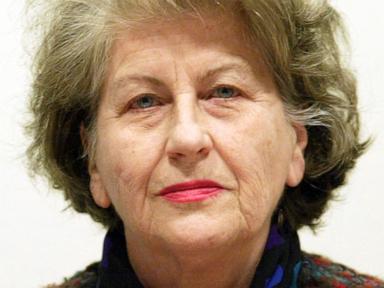
History rarely hands us simple villains. Instead, it offers figures who walk out of elite universities, trade in intellectual circles, and then calmly endorse ethnic cleansing. Biljana Plavsic was precisely that kind of figure. When the former Bosnian Serb leader passed away in Belgrade at the age of 94, headlines noted her legacy as a convicted war criminal. But obituary writers often missed the mechanics of how a university professor of biology became one of the chief architects of the breakup of Yugoslavia.
If you want to understand how the wars of the 1990s started, you cannot just look at generals and paramilitaries. You have to look at the academics who gave them intellectual cover.
The Evolution From Biologist to Ultranationalist
Born in Sarajevo in 1930, Plavsic spent decades looking through microscopes long before she ever looked at ethnic maps. She earned a doctorate in biological sciences, studied in Zagreb and Prague, and eventually became a dean at the University of Sarajevo. Colleagues remembered her as meticulous and quiet.
By the late 1980s, that quiet academic vanished. As nationalism swept through the crumbling republics of Yugoslavia, Plavsic joined Radovan Karadzic to found the Serbian Democratic Party. She didn't just participate in politics; she weaponized her scientific background. She began describing ethnic groups in biological terms, arguing that cohabitation between Serbs, Croats, and Bosniaks was a genetic impossibility.
That shift matters. When political disputes are reframed as biological imperatives, violence stops looking like a crime and starts looking like natural hygiene.
At the Height of Power and Atrocity
When the Bosnian War erupted in 1992, claiming over 100,000 lives and displacing millions, Plavsic served as co-president of the self-proclaimed Serb Republic. Throughout the siege of Sarajevo and the horrific campaigns of ethnic cleansing across eastern Bosnia, she was a central figure in the leadership command.
She famously boasted that two million Serbs could afford to die so that the rest could live in a pure ethnic state. While international diplomats negotiated failing peace accords, hardliners like Plavsic pushed for total separation.
Yet, history took a strange turn after the 1995 Dayton Peace Agreement. While Karadzic and military commander Ratko Mladic went on the run, Plavsic remained visible. She even had a falling out with Slobodan Milosevic, whom she considered insufficiently radical during the war, but later criticized for being too autocratic.
The Guilty Plea and the Aftermath
In 2001, Plavsic did something almost unheard of among high-ranking Balkan leaders: she surrendered to the International Criminal Tribunal for the Former Yugoslavia in The Hague. She pleaded guilty to crimes against humanity, expressing what she called moral responsibility for the suffering inflicted during the war.
The tribunal sentenced her to 11 years in prison. Many victims' families felt the plea was a calculated maneuver to drop other charges, including genocide. They were proven right in spirit when, after serving two-thirds of her sentence in a Swedish prison, she was released in 2009.
Upon her return to Belgrade, greeted by government officials, she promptly recanted her confession. She claimed she only pleaded guilty to secure a lighter sentence and spare herself a grueling trial. That reversal erased whatever small measure of redemption she had briefly claimed.
Why Her Death Still Stirs Anger Today
Plavsic lived out her final years quietly in Belgrade, insulated from remorse and largely shielded by a political culture in Serbia and Republika Srpska that still minimizes wartime atrocities. Her death marks the quiet end of a generation of leadership that tore the Balkans apart.
Yet the ideology she helped midwife didn't die with her. Revisionist history continues to thrive across the region, where convicted war criminals are often treated as folk heroes rather than perpetrators of mass violence. Remembering Plavsic isn't just an exercise in historical housekeeping. It's a reminder of how quickly civilization can unravel when intellectuals decide that human lives are expendable for the sake of an ethnic map.