History loves a tidy narrative, but the shadows of September 11, 2001, refuse to stay neatly filed away. For decades, the official line treated Omar al-Bayoumi as a footnote—a friendly, happenstance acquaintance who just happened to bump into two future hijackers in Southern California. The narrative portrayed him as an ordinary guy trying to help fellow Muslims navigate a foreign culture.
That version has completely unraveled.
With newly unsealed federal court files, forgotten evidence from British police raids, and ongoing lawsuits led by victims' families, the portrait of al-Bayoumi has shifted. He wasn't just a friendly neighbor. He functioned as a critical logistics facilitator for Nawaf al-Hazmi and Khalid al-Mihdhar, the first two al-Qaeda hijackers to touch American soil. If you look closely at how they survived those crucial first months in San Diego without speaking English or knowing how to function in the West, you find al-Bayoumi's fingerprints everywhere.
The San Diego Landing Pad
When Hazmi and Mihdhar flew into Los Angeles in January 2000, they were flying blind. They had just attended a high-level al-Qaeda summit in Malaysia, but they lacked basic survival skills in America. They didn't speak the language. They had no local network.
According to investigative findings, al-Bayoumi didn't just meet them by accident at a restaurant. He took them under his wing with remarkable efficiency. He helped them secure an apartment right in his own complex in San Diego. He co-signed their lease, fronted cash for deposits, helped them open bank accounts, and hooked them up with driver's licenses and flight school information.
Without that hands-on assistance, those two hijackers might have drawn immediate suspicion, run out of money, or given up and gone home. Al-Bayoumi essentially built them a runway.
The Intelligence Connection Versus the Official Line
For years, federal investigators insisted al-Bayoumi was an unwitting actor. The 9/11 Commission Report leaned heavily toward that interpretation, describing him as an unlikely candidate for clandestine extremist plots. But former field agents have pushed back hard against that assessment.
Investigative files reveal that al-Bayoumi was receiving a generous financial stipend through a Saudi civil aviation entity while living as a student in California—despite doing little to no actual work for it. Later FBI and intelligence assessments noted that he operated with ties to the Saudi intelligence apparatus and met with radical clerics and diplomatic personnel like Fahad al-Thumairy just before connecting with the hijackers.
The Saudi government has consistently denied any state complicity, maintaining that al-Bayoumi acted entirely on his own accord and had no knowledge of the impending attacks. Yet, pieces of physical evidence recovered from his British apartment after 9/11 complicate that defense immensely.
The Evidence Left Behind in Birmingham
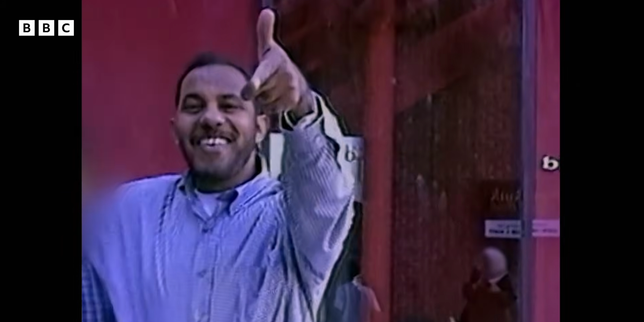
When British authorities arrested al-Bayoumi in Birmingham, England, ten days after the attacks, they raided his residence. They seized boxes of documents, address books containing high-level government contacts, and a series of videotapes.
One of those videotapes shocked investigators when it finally resurfaced publicly years later. Filmed in 1999, it showed al-Bayoumi recording pre-operational footage of the U.S. Capitol—capturing entrances, security posts, and architectural layouts. Alongside that video, investigators discovered a handwritten document featuring an airplane sketch and mathematical formulas that experts say could calculate descent rates for hitting a distant target.
Why didn't this explosive material blow the case wide open in 2001? Bureaucratic compartmentalization and lost paperwork played a massive role. Some of the seized British evidence sat forgotten in Washington warehouses for over a decade, never making it down to the field agents who desperately needed it while building their initial cases.
Why This Matters Today
The debate over al-Bayoumi isn't just about historical pedantry. It sits at the heart of ongoing legal battles between 9/11 victims' families and the Saudi government under the Justice Against Sponsors of Terrorism Act (JASTA). Every newly declassified memo or unsealed court transcript chips away at the wall of official deniability.
You cannot understand the mechanics of the 2001 attacks by looking only at the pilots inside the cockpits. You have to look at the support systems on the ground—the apartment leases, the translation help, the funding streams, and the local handlers who kept the plot alive during its most vulnerable infancy.
Al-Bayoumi left the United States right before the tragedy and returned to a quiet life abroad, avoiding criminal charges in the West. But the paper trail he left behind tells a story that official reports spent years trying to minimize. The complete picture of September 11 is still being written, one declassified document at a time.