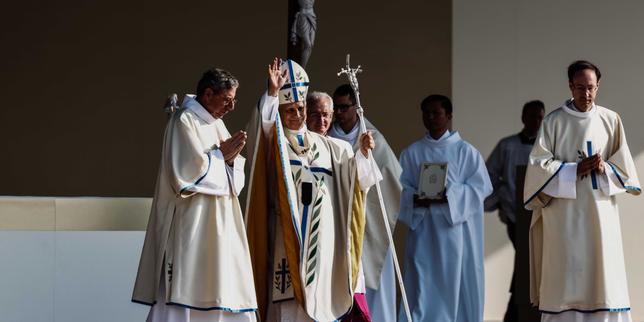
Pope Leo XIV spent the last couple of days turning French politics and public spaces upside down. If you've been tracking his September 2026 apostolic journey, you know it's already packed with massive crowds, high-stakes diplomatic talks, and deeply personal moments. Following intensive stops at the Élysée Palace with President Emmanuel Macron, UNESCO, and Notre-Dame, the pontiff shifted his focus to a massive open-air Eucharist at the Place de la Concorde before catching a flight to Lourdes.
Let's look past the surface headlines to unpack what's actually happening on the ground and why this particular trip matters so much for modern Europe.
The Core Message at Place de la Concorde
During his landmark mass at the Place de la Concorde on Saturday, September 26, Pope Leo delivered a line that instantly dominated headlines across Europe. He reminded tens of thousands of gathered faithful that "none of us is a number on an identity card, nor a registration number, but a unique person."
It's easy to dismiss papal speeches as standard theological rhetoric. But in a modern secular state dominated by bureaucratic administration, digital tracking, and polarizing political debates over immigration and identity, drawing a sharp line between human dignity and state registry numbers carries heavy weight. The speech struck a nerve because it directly challenges how modern societies categorize individuals.
President Emmanuel Macron responded shortly after the mass, noting on social media that France felt genuinely proud to host the Pope. Yet the ideological tension between a fiercely secular republic (laïcité) and a global religious leader offering moral critiques on modern technocracy is precisely what makes this visit so compelling.
Behind the High-Security Itinerary
You can't talk about this trip without looking at the sheer logistical footprint. This marks the first official papal visit to the French capital since 2008, and local authorities didn't take any chances. Major metro stations like Concorde, Champs-Élysées - Clemenceau, and Franklin D. Roosevelt faced heavy closures as security perimeters locked down central Paris.
Beyond the pomp, the itinerary included deeply serious private engagements that rarely get captured in standard tourist snapshots. Vatican officials confirmed that during his four-day journey—which also spans stops in Metz and the Marian sanctuary of Lourdes—Pope Leo met privately with victims of church abuse. Critics and survivors' advocates have rightly pushed the Vatican for tangible accountability, making these closed-door meetings a critical litmus test for the pontiff's actual impact compared to his predecessors.
Moving Beyond Paris Toward Lourdes and Metz
Paris was only the starting gun. Immediately following the Concorde mass, Pope Leo boarded a flight toward the Sanctuary of Our Lady of Lourdes, setting up a weekend centered around prayer at the Massabielle Grotto and meetings with the French Episcopal Conference.
The final leg of the tour on Monday, September 28 will take him to Metz—the hometown of Robert Schuman, one of the foundational architects of the European Union. By tying his itinerary from Paris to Lourdes and finishing in Metz for an interreligious summit on European unity, the Vatican is sending a deliberate message about the spiritual roots of peace on the continent.
Whether you view these high-profile visits through a lens of faith, politics, or cultural heritage, they expose the ongoing negotiation between sacred traditions and secular institutions in 2026. Keep an eye on how local French communities respond as the tour winds down in the days ahead.