Commercial aviation relies on a fragile web of trust. Passengers strap into pressurized metal tubes, assuming the two people up front have been vetted, stable, and mentally fit. But what happens when the security net breaks down completely?
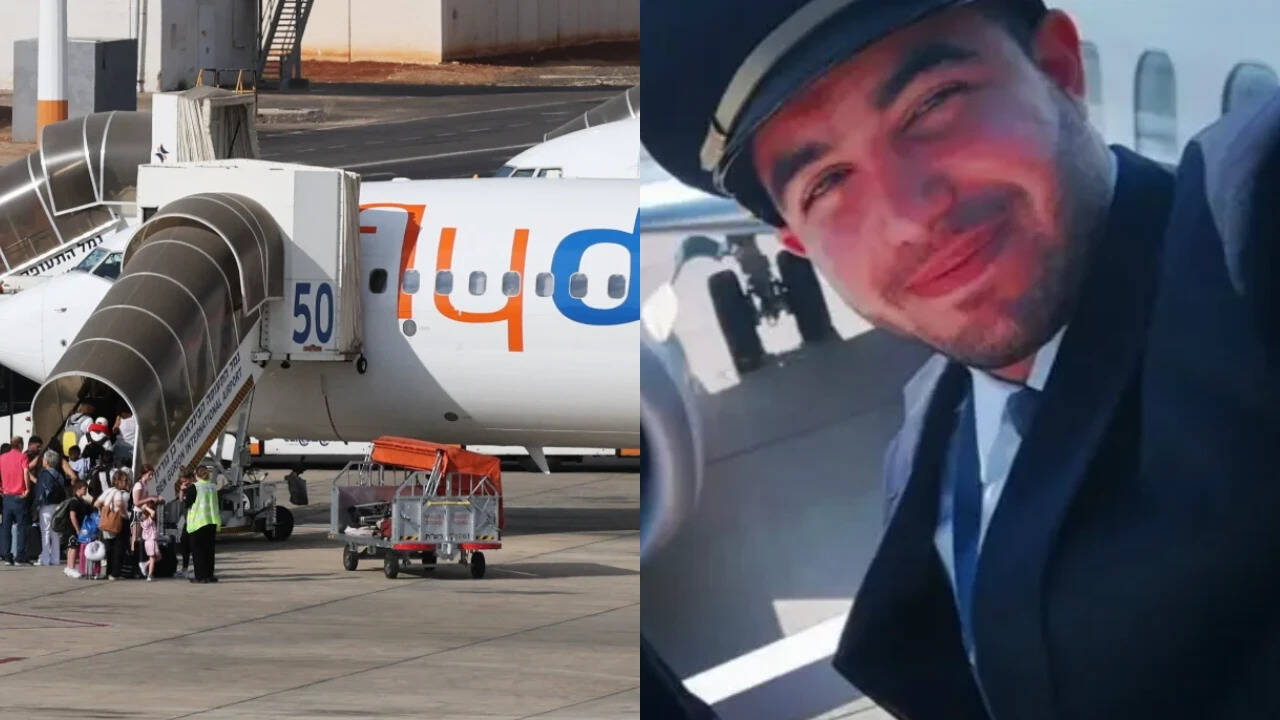
A horrifying cockpit attack aboard Flydubai flight FZ1073 from Dubai to Tel Aviv shattered that illusion. The incident involved an Omani co-pilot, identified as Hamam al-Hammami, who allegedly turned on the captain with an emergency crash axe. New investigative findings suggest the attack was only the opening phase of a much darker plot to bring the Boeing 737 down in the Saudi desert.
The Anatomy of a Cockpit Betrayal
Flight FZ1073 was cruising smoothly when violence erupted in the flight deck. According to reports from the Italian newspaper Corriere della Sera, the co-pilot repeatedly struck Indian captain Smit Machchhar with a crash axe.
Injured and bleeding, the captain managed to activate the cockpit door release switch. Additional pilots rushed to the flight deck, while panicked passengers realized something was terribly wrong. Realizing his plan to seize control of the aircraft had hit a wall, al-Hammami allegedly shifted tactics to total destruction.
He disconnected the autopilot and violently shoved the control column forward. The Boeing 737 plummeted roughly 16,000 feet in less than a minute. Aviation experts later likened the terrifying plunge to a vertical roller coaster. Passengers experienced extreme weightlessness and sheer terror before courageous passengers and crew managed to overpower the attacker and level out the aircraft.
The Scarier Question: Did He Cut the Engines?
While the initial physical assault and rapid descent shocked the aviation world, subsequent analysis of flight data and video footage uncovered an even more alarming possibility.
Two veteran Boeing 737 captains reviewing cabin videos noticed something unusual: emergency lights inside the passenger cabin flickered on during the flight. Under normal cruising conditions, these battery-backed lights remain off. They only activate when a 737 loses its primary electrical power supply—an event triggered if aircraft generators or engines are intentionally shut down.
Investigators are examining whether al-Hammami manipulated the fuel control switches from the "Run" position to "Cutoff" during the chaos. If true, it means the co-pilot wasn't just trying to dive the plane; he may have actively starved the engines of fuel to ensure the aircraft couldn't recover.
Communication Chaos in Mid-Air
As the crisis unfolded, the flight crew struggled to communicate their emergency status to air traffic controllers on the ground.
One of the pilots transmitted squawk code 7700, the universal signal for a general onboard emergency. Air traffic controllers initially had no idea what kind of emergency they were dealing with. Seven minutes later, as the plane approached Jordanian airspace, the crew changed the transponder code to 7500, which specifically denotes an unlawful interference or hijacking.
Controllers first instructed the crew to turn back, then redirected flight FZ1073 toward Tabuk in Saudi Arabia for an emergency landing. UAE authorities later classified the event as a deliberate terrorist attack.
Vetting Failures and Systemic Blind Spots
The most disturbing element of this incident isn't just what happened inside the cockpit, but how the co-pilot got there in the first place.
Reports indicate that al-Hammami had already been barred from flying by his home country of Oman due to documented concerns over extremist views. Despite this glaring red flag, he managed to secure a position with Flydubai.
International aviation protocols dictate that airlines and authorities share passenger and crew manifests before international flights. Israel confirmed it received the crew list for flight FZ1073, but no automated security warnings were triggered. Israeli officials argued that local authorities bear the responsibility for vetting local flight crews, noting that foreign transport ministries lack the resources or intelligence tools to screen every individual pilot crossing their borders.
Prime Minister Benjamin Netanyahu ordered the head of the National Security Council to launch a comprehensive review of foreign civil aviation security protocols. Meanwhile, the co-pilot's employment paper trail revealed a string of rejections and short stints. Royal Air Maroc confirmed he completed three months of training in 2025 but was rejected for a permanent job. Buckinghamshire New University noted he completed a distance-learning course in aviation management rather than practical pilot training, and Australian police started investigating his past ties to Melbourne universities.
What Needs to Change Now
Aviation security has historically focused on keeping malicious actors out of the cabin using strict baggage checks, metal detectors, and reinforced cockpit doors. The Flydubai incident exposes a gaping hole in that architecture: insider threats.
When the threat wears an epaulet and sits in the left or right seat, standard checkpoint rules become useless. Airlines must overhaul pilot vetting procedures, implement rigorous psychological evaluations, and establish cross-border intelligence-sharing networks that immediately flag pilots whose licenses or security clearances have been revoked locally.
The industry cannot afford to treat rogue pilots as isolated statistical anomalies. Without unified global standards for continuous background monitoring, complacency will invite the next disaster.