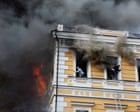
Air raid sirens used to mean a midnight scramble to the basement. Now, they're just a frustrating soundtrack to a working Monday. When a Russian jet-powered drone slammed into the historic National Academy of Sciences in central Kyiv, it wasn't an isolated nighttime terror. It happened in broad daylight, shattering a 19th-century building, killing at least one person, and forcing staff to climb out of second-floor windows while flames tore through offices.
If you're wondering how the war in Ukraine has evolved by late 2026, look right at the shifting tactics in the capital. Moscow isn't just trying to destroy infrastructure anymore. They're trying to crush civilian rhythm through relentless daytime air raids.
The Target That Wasn't Military
The National Academy of Sciences sits right in the historic heart of Kyiv. It's close to the German embassy, the National Opera, and St Volodymyr's Cathedral. Anatoliy Zagorodny, the academy's president, stood outside the burning building and stated the obvious: his researchers aren't soldiers.
Yet, the distinction between civilian research institutions and military assets has completely blurred in this conflict. Among those injured in the blast was Volodymyr Horbulin, the academy's first vice-president and a veteran security official. At the same time, another drone tore through a private medical clinic nearby, killing another civilian.
Moscow's strategy has noticeably shifted toward daytime hours. Kremlin spokesperson Dmitry Peskov made no secret of the intent, telling reporters that Ukraine would "pay a price" for recent cross-border strikes inside Russia. Launching drones in the middle of the day forces major city populations to spend hours under continuous alert, grinding down public resilience and keeping the economy under permanent stress.
Why Newer Jet-Powered Drones Change Everything
The physical nature of these attacks is also changing rapidly. For years, the standard threat came from slower, propeller-driven Shahed or Geran-2 models humming across the night sky at around 300 km/h.
Now, newer jet-powered systems like the Geran-4 and Geran-5 variants are entering the mix. These weapons fly at speeds reaching up to 600 km/h, slashing response times for air defense crews and making standard intercept methods much harder.
Ukraine's air defense units are racing to scale up faster interceptors, but the technological arms race favors the aggressor when attacks happen at this velocity. When a faster drone hits a crowded urban center in daylight, the margin for error drops to zero.
The Spillover Threat to NATO Borders
The danger isn't staying localized to Kyiv. On the exact same day, a Russian jet-powered drone crossed deep into western Ukraine, striking dangerously close to the Polish border.
This prompted Warsaw to scramble military aircraft and issue urgent air defense warnings to residents in the eastern Lublin region. Poland and other neighboring states are staring down a persistent security threat as border crossings and logistics hubs turn into frontline targets. Kyiv is even weighing whether to relocate joint customs checkpoints directly onto neighboring sovereign territory to keep personnel safe.
What Happens When Fatigue Sets In
Daily air raid alerts during working hours create a grim psychological calculus for ordinary Ukrainians. Many people simply choose to stay at their desks rather than lose hours in underground shelters. Buildings hit during daytime operations are routinely occupied because life has to go on.
President Volodymyr Zelenskyy urged western allies to ramp up immediate pressure on Moscow, pointing out that these casualties are entirely preventable if total economic and diplomatic constraints are applied. But with peace talks stalled and U.S.-brokered initiatives showing zero traction, both sides are digging in for a brutal escalation phase.
The strategy moving forward requires recognizing that traditional air defense models cannot cope with fast jet-powered drones without massive technological backing from international partners. If you're tracking the trajectory of this conflict, the frontline isn't just a trench in the east anymore. It's every office building, hospital, and science academy in Kyiv.