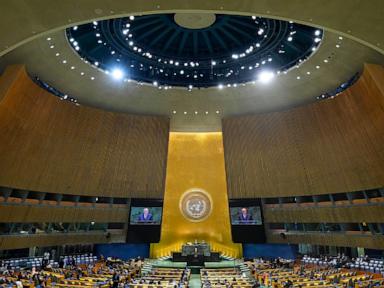
Every autumn, New York City turns into a heavily guarded fishbowl where global leaders gather to tell each other that humanity faces existential threats. They step up to the green marble rostrum at the United Nations General Assembly, adjust the microphone, and deliver identical warnings about climate collapse, artificial intelligence risks, and runaway militarism. Then they fly home.
If you watch these speeches year after year, a profound exhaustion sets in. The rhetoric is grand, emotional, and deeply unified. Everyone agrees we're in this together. But walk past the diplomatic pleasantries and look at the actual machinery of international governance, and a glaring question emerges: how does any of this collective survival actually work when nobody wants to share real power?
The Great Disconnect Between Rhetoric and Reality
This year's General Assembly made the core tension impossible to ignore. More than 150 national leaders took the stage, and their messages split cleanly into two irreconcilable camps. On one side stood the desperate acknowledgment that modern crises do not respect national borders. Artificial intelligence algorithms write code that crosses continents in milliseconds. Carbon emissions from one hemisphere melt ice caps that protect coastal cities thousands of miles away.
As Sri Lanka's foreign minister, Vijitha Herath, bluntly pointed out during the sessions, there are problems which no country can solve alone. You cannot build a wall high enough to keep out a changing climate or a global pandemic.
Yet on the other side of the debate sat an overwhelming sense of institutional failure. Leaders aren't just worried about external threats; they're losing faith in the very global bodies built to manage them. Alexandra Hill Tinoco, the foreign minister of El Salvador, captured the room's mounting frustration with a sharp question: Where are the United Nations? Do we have an organization that is still relevant?
When sovereign states look at the Security Council and see a permanent group of veto-wielding superpowers deadlocked by geopolitical rivalries, they don't see a referee. They see a broken system protecting a status quo that stopped working decades ago.
The Illusion of Sovereign Equality
Multilateralism is the economic and political reality of our century. Nations are chained together by global supply chains, financial markets, and shared atmospheric systems. But the governance model running this network belongs to the mid-twentieth century.
Smaller nations feel this imbalance acutely. Philip Edward Davis, the prime minister of the Bahamas, cut straight through diplomatic niceties to expose the power dynamic at play. The message to small nations is clear, he argued. Be as sovereign as we allow you to be. A sovereignty that requires permission is not a sovereignty.
When island nations watch their entire landmasses slowly drown beneath rising seas, abstract debates in air-conditioned committee rooms feel like cruel theater. They aren't asking for charity; they are demanding structural reform.
The same frustration drives the fierce push from African nations for permanent seats and veto power on the UN Security Council. Leaders from the continent point out that a governing body designed after World War II to manage European and American interests cannot credibly speak for a planet of eight billion people today. As continental leaders argued from the rostrum, Africa isn't asking for a favor. It is claiming its rightful place at the table.
Why the Current System Stagnates
The structural flaw of global governance is simple. It relies on voluntary compliance from entities whose primary incentive is national self-interest.
When a superpower decides to ignore international consensus, nothing stops it. When an economic powerhouse prioritizes domestic growth over global emission targets, the penalties are nonexistent. The UN was structured to prevent World War III, and on that front, it has largely succeeded. But it was never engineered to manage fast-moving transnational crises like rogue AI development or ecological collapse.
Austria's minister for European and International Affairs, Beate Meinl-Reisinger, put it best when addressing the assembly. The United Nations was not created to discuss international problems, she noted. It was created to solve them.
Right now, it spends ninety percent of its energy on the former while starving the latter of political will. Speeches are written to satisfy domestic audiences back home. Resolutions pass with broad majorities and zero enforcement mechanisms. Everyone respects the abstract ideal of a global fraternity, but nobody trusts their rivals enough to surrender a fraction of their sovereignty to enforce it.
Moving Beyond Talk
If we are genuinely in this together, the rules of engagement have to change. Continuing to treat global summits as annual therapy sessions where grievances are aired and ignored will only accelerate the collapse of trust in multilateral institutions.
Fixing this requires structural surgery. It means expanding the Security Council to reflect twenty-first-century demographics instead of nineteen-forties victors. It means stripping unilateral veto powers that turn international crisis management into a hostage negotiation. Most importantly, it means tying global funding and economic partnerships directly to compliance on existential threats.
Stop talking. Start acting. Until global leaders are willing to trade comfortable rhetoric for uncomfortable concessions, every grand declaration at the United Nations remains just noise echoing off green marble.