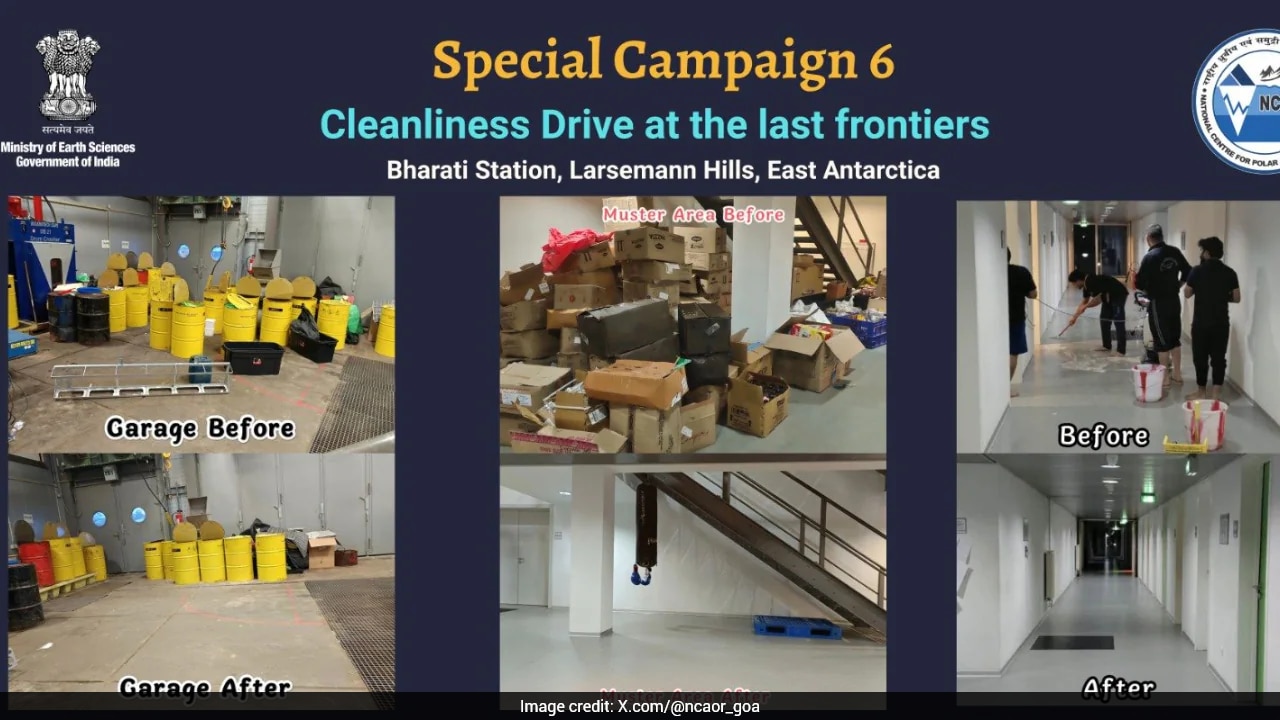
The wind outside howls at a brutal minus 48 degrees Celsius. Most human beings are solely focused on survival inside reinforced steel structures. Yet, half a world away from mainland streets, India's sanitation drive just reached the frozen wilderness of Antarctica.
National sanitation policies usually conjure images of urban street sweeping, village waste management, or municipal campaigns under local sun. But the 45th Indian Scientific Expedition to Antarctica flipped that script entirely. Winter teams stationed at Maitri and Bharati took the Swachh Bharat Mission to the white continent. They carried out rigorous cleanliness and space-optimisation drives when the rest of the planet assumes nothing moves under deep polar freezes.
People often roll their eyes at government cleanliness campaigns, treating them as superficial photo-ops. But launching these drives in extreme environments points to a deeper shift in how scientific outposts manage their footprint. Antarctica isn't just a snowy wasteland. It is a fragile international scientific preserve governed by strict environmental protocols.
Why Antarctica Demands Zero Tolerance for Waste
If you leave a plastic wrapper or drop organic debris on normal soil, nature eventually digests it. Drop something on the ice cap, and it stays preserved for decades, frozen in time. Antarctica operates under the Madrid Protocol on Environmental Protection, which treats the entire continent as a natural reserve dedicated to peace and science.
Every nation operating a base there faces intense scrutiny. India has maintained a presence on the continent for decades, starting with the establishment of Maitri in 1988 on the Schirmacher Oasis, followed by the modern Bharati station on the Stornes Peninsula in 2012. Managing waste at these remote outposts is a logistical nightmare. You cannot simply throw trash into a local municipal landfill. Everything generated by scientists, support staff, and winter crews must be sorted, stored, and eventually shipped back out, or handled through advanced incinerator tech that meets rigid polar standards.
When the National Centre for Polar and Ocean Research (NCPOR) announced that the winter team led by Scientific Officer Huidrom Nageshwar Singh was tackling pending waste and spatial decluttering under the Special Campaign 6 framework, it highlighted a gritty reality. Cleanliness at minus 48 degrees isn't about looking nice for local politicians. It is about cargo efficiency, safety, and strict environmental compliance.
The Real Logistics of Living at the Bottom of the World
Let's talk about what daily life actually looks like at Maitri and Bharati. These aren't temporary tents. They are engineering marvels built on steel stilts or designed with small footprints to withstand fierce polar winds without getting buried under drift snow.
Maitri supports around 25 people during the punishing winters. Bharati accommodates nearly double that on a twin-sharing basis. Inside these main buildings, you get regulated power, automated heating, running water, and containerised labs connected to the Indian mainland via dedicated satellite channels.
Living in tight quarters with the same group of people for months on end takes a psychological toll. Clutter breeds frustration. Space optimisation and strict sanitation aren't just administrative buzzwords; they keep morale high. When you share a closed habitat where going outside can lead to frostbite in minutes, an unorganised workspace or equipment backlog can turn into a serious hazard.
Furthermore, the winter teams take over only after the summer hustle wraps up. Summer operations involve heavy cargo drops, complex marine deployments, and international collaborations—such as joint work with UAE scientists from Khalifa University. By the time the summer crew leaves and the winter isolation sets in, sorting out the backlog of supplies, clearing out redundant materials, and auditing storage bays become critical tasks.
Breaking Stereotypes in Polar Science
Another detail worth noting is the evolving demographics of these extreme expeditions. The winter crew at Bharati Station includes three Indian women—two scientists and a medical doctor. For decades, polar expeditions were heavily male-dominated domains. Seeing diverse teams tackle harsh wintering duties proves that modern scientific outposts are changing.
When these teams integrate standard institutional frameworks like national cleanliness drives into polar operations, they bridge the gap between domestic governance and international scientific responsibility. It shows that institutional habits, when practical, scale up to the most isolated places on Earth.
You don't need a massive bureaucratic rollout to understand the core takeaway here. Whether you are running a corporate office in Mumbai or managing a research lab in Queen Maud Land, the principle remains identical. Clean spaces reduce risk, preserve delicate environments, and keep systems running when failure is not an option.
Take a hard look at your own workspace today. If researchers can maintain pristine order and environmental discipline while fighting a minus 48-degree freeze in Antarctica, you can clear out the clutter sitting on your desk. Stop waiting for ideal conditions to get organized. Fix your immediate environment first.