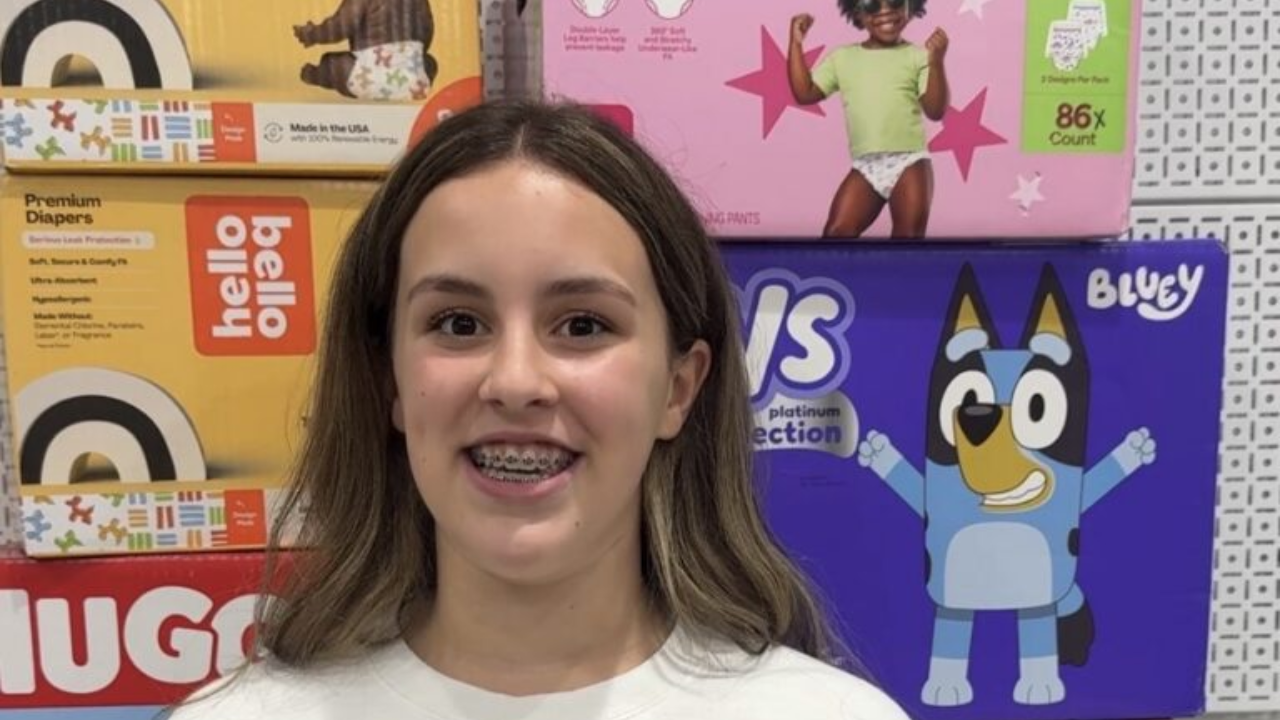
Most kids spend their seventh year figuring out elementary school friendships and losing teeth. Sloan spent hers looking at empty shelves and deciding to fix a quiet crisis. When she first walked into the Nourish Phoenix food bank back in 2022 alongside her mother, she didn't expect to witness a quiet emergency. She saw bare metal racks where diapers were supposed to sit. That single moment sparked an annual mission that has now completely upended local expectations of what a child can achieve.
Fast forward five years, and that same girl is now 12 years old. For her fifth annual diaper drive, she set an ambitious target of 22,500 diapers. It felt like a stretch to most. Instead, she blew past that goal by thousands, rolling up to the food bank with a massive U-Haul truck packed to the ceiling with 30,000 diapers.
The Hidden Safety Net Crisis Nobody Talks About
If you haven't looked closely at how basic assistance programs work in America, you probably assume safety nets cover everything a family needs. They don't. Programs like SNAP (Supplemental Nutrition Assistance Program) and WIC (Special Supplemental Nutrition Program for Women, Infants, and Children) cover groceries and basic nutritional items. They explicitly exclude diapers.
That distinction creates an immediate trap for low-income parents. According to data from the National Diaper Bank Network and Huggies, roughly one in three American families struggle to afford enough diapers to keep their babies clean and dry. When cash gets tight, parents face impossible choices between buying food, paying utilities, or purchasing basic hygiene supplies. Diapers routinely cost upwards of eighty dollars a month per child. For families visiting community hubs like Nourish Phoenix—which has served the area since the 1960s with food, job assistance, and clothing—every single dollar counts.
When Sloan asked why those specific shelves were empty during her volunteer shift, staff explained that diapers are among their most requested items and always vanish immediately. That conversation changed everything.
How a Simple Social Post Sparked a Community Movement
Sloan didn't launch with a massive non-profit board or corporate sponsors. On the car ride home from that eye-opening food bank visit, she simply turned to her mom and said, "Mom, we should get some diapers and bring them back for Nourish Phoenix."
That initial spark started with a single social media post asking friends and neighbors for help. Her first drive pulled in around 7,000 diapers. That might sound impressive for a seven-year-old, but what happened next is where the real lesson lies. She didn't treat it as a one-off good deed. She turned it into a consistent, growing enterprise.
By her fifth drive, word had spread far beyond her immediate neighborhood. Donations of Pampers, Huggies, and budget packs kept arriving at her family's house in droves. Boxes stacked up so high in the living room that walking became an obstacle course. Friends, local supporters, and community members rallied behind her energy. When the drive wrapped up at the close of August, the final tally hit an astounding 30,000 units.
What We Can Learn From Sloan's Drive
Too often, we wait for massive institutions or government grants to solve systemic problems. We assume that if a crisis is big—like infant poverty and family resource gaps—it requires a massive corporate initiative to fix it. Sloan's journey proves otherwise.
Real change usually starts with noticing a specific gap in your own backyard and refusing to ignore it. You don't need a million-dollar foundation to make a tangible dent in local poverty. You need persistence, a clear goal, and the willingness to ask your community for help.
If you want to support families in your own area, don't just write a check and forget about it. Call your local food bank or pantry today and ask them what specific non-food items they run out of first. Chances are, it's diapers, feminine hygiene products, or basic cleaning supplies. Organize a small collection box at your workplace, your gym, or your kids' school. Take a page out of Sloan's playbook, set a concrete target, and get to work filling those empty shelves.