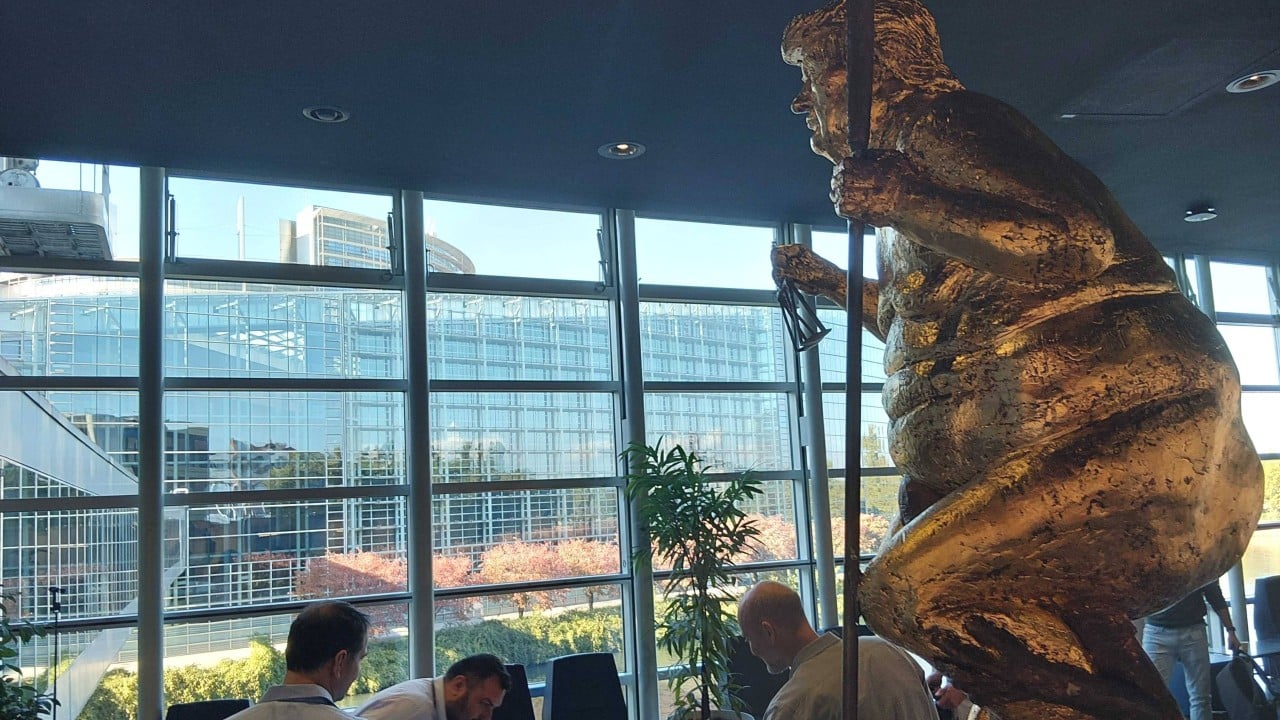
Art in politics rarely punches subtly. When a giant, gilded, completely naked statue of Donald Trump appeared inside the European Parliament building in Strasbourg, it immediately stopped morning commuters in their tracks.
Created by Danish sculptor Jens Galschiøt, the piece is officially titled The Orange Plague or The King of Injustice. It shows an unclad Trump perched comfortably on the shoulders of a much smaller, strained man, holding a golf club that doubles as a scepter and a tiny globe. At the base, an inscription reads: "I am sitting on the back of a man. He is sinking under my burden. I will do anything to help him. Except stepping down from his back."
People love to dismiss these stunts as mere trolling. That is a mistake.
Protest art of this scale inside a major international legislative body tells us something vital about how foreign politicians view the current geopolitical chessboard. European institutions are growing frustrated. Leaders behind closed doors are tired of walking on eggshells. They worry about tariffs, sudden foreign policy shifts, and the systematic dismantling of international climate agreements. Yet, expressing those fears diplomatically often results in watered-down communiqués that nobody reads.
So, lawmakers turn to provocative sculptures.
Danish member of the European Parliament Per Clausen sponsored the exhibition. His defense was blunt. He noted that if international politicians are too thin-skinned to handle a satirical statue, they don't belong on the world stage. Galschiøt himself has a long history of making people uncomfortable through public installations. He is the artist behind the infamous Pillar of Shame series, and he brought this specific piece straight from the COP30 climate summit in Brazil, with plans to move it next to COP31 in Turkey.
The Message Behind the Gold Leaf
The artistic choice to cover the sculpture in 23-karat gold leaf isn't random. It directly references Hans Christian Andersen's classic fairy tale The Emperor's New Clothes. The underlying argument is simple. Trump relies on outward displays of wealth, power, and flashiness to convince followers of his innate superiority, while actively avoiding substantive accountability—especially concerning global environmental crises.
The imagery of the smaller man bearing the weight represents ordinary citizens and developing nations who shoulder the brunt of carbon emissions and erratic trade wars. Trump sits on top, insulated by spectacle, holding a golf club and a scale of justice that tips entirely in his favor.
Critics from conservative circles often call these installations disrespectful or claim they amount to political harassment. But political satire targeting sitting or former world leaders has a long, protected history in Western democracies. From giant inflatable chickens near the White House to nude effigies suspended outside Las Vegas, physical mockery remains a primary tool for dissent when traditional diplomatic channels stall.
What Happens Next
The statue's residency in Strasbourg was brief, ending quickly before its next transit. But the ripple effect is already visible. Thousands of 3D-printed miniature versions of the statue were handed out to parliamentary staff and visitors, turning a temporary museum piece into a distributed meme and a mobile call to action.
When mainstream politicians sponsor provocative art, they signal a shift in posture. They are done pretending that traditional etiquette will curb populist pressure. You don't have to like the aesthetic of a naked, golden effigy to understand its utility. It forces a conversation that institutional bureaucrats would otherwise prefer to ignore.