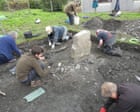
History isn't just written by the victors. Sometimes, it gets dug up by a bunch of retired locals with a shovel and a stubborn dream.
On the tiny Scottish island of Lismore, where the population sits around 190 and you won't find a single retail chain or pub, a local historical society just upended what experts thought they knew about the early spread of Christianity in Britain. Armed with community grants, crowdfunding, and sheer grit, residents teamed up with professional archaeologists to excavate beneath a later medieval cathedral site.
What they found was staggering. Instead of an isolated backwater church, they unearthed the remnants of a major sixth-century monastic powerhouse. We aren't talking about a few scattered stones. They found extensive burial grounds, intricate decorated stonework, early buildings, and a massive cache of tiny crucibles used to cast gold, silver, and copper into high-status jewellery during the seventh century.
If you've only ever heard of Iona when studying early Scottish monasteries, you're not alone. For centuries, Saint Columba and his famous island foundation have hogged the historical spotlight. But the discoveries on Lismore force a total recalibration of how Christianity actually spread across northern Britain.
Why Saint Moluag Deserves Better PR
History has an annoying habit of playing favorites. Saint Columba hit the jackpot because he had a dedicated hagiographer write a glowing, widely read biography centuries later. Saint Mo Luóc, also known as Moluag, founded the Lismore monastery (known historically as Lios Mór) around the same time. Yet because he lacked a slick PR agent in the form of an eager medieval writer, his legacy faded into a local footnote.
These new finds prove Moluag was running a major international hub of religion and elite craftworking. When volunteers pulled microscopic metalworking crucibles out of the boggy Scottish soil, they realized local monks weren't just praying—they were crafting luxury goods that signaled immense wealth and political reach. This was a heavyweight site, operating on the same tier as Iona, right out in the Inner Hebrides.
How Ordinary People Are Rewriting Archaeology
Most major digs rely on massive academic backing or deep corporate pockets. Lismore flipped that model on its head.
Robert Hay, a retired plant scientist who moved to the island in 2001, didn't wait for a university department to come knocking. He and a dynamic minority of islanders banded together, raised the modest five-figure funding needed, and brought in Dr Clare Ellis of Argyll Archaeology.
Professor Gordon Noble of the University of Aberdeen points out that this bottom-up approach is what makes the Lismore project so refreshing. It wasn't academics parachuting in with a pre-written theory. It was the community itself driving the shovel into the earth to reclaim their own past.
What This Means for You
You don't need to be a professional historian to realize that textbooks are full of gaps. Whenever you assume the past was simple, centralized, or well-documented, you're usually missing half the story.
If a population of less than two hundred people can rewrite the medieval map of Scotland through sheer community willpower, local history matters. Keep an eye on the forthcoming edition of Antiquity, where the full excavation results are set to drop. Until then, remember that the most exciting historical breakthroughs often happen where nobody is looking.