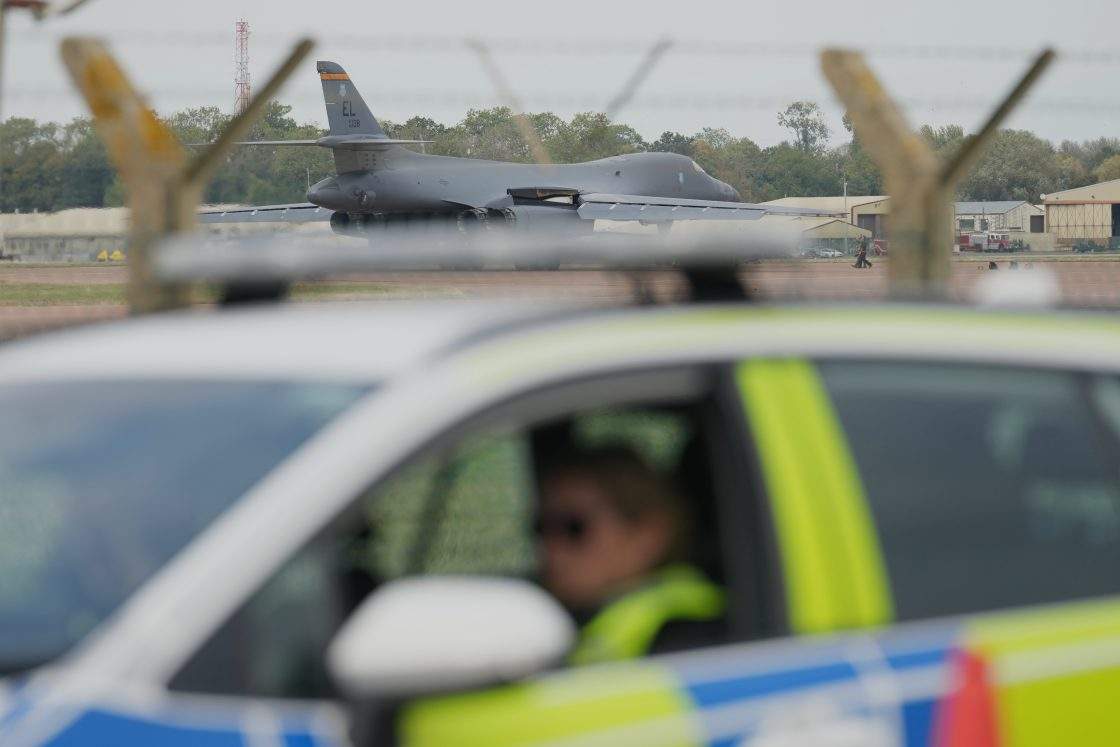
Counterterrorism police just hauled in a twenty-two-year-old man in central London, marking the seventh arrest in an escalating security crisis at a vital British airfield. This isn't just another routine police blotter item. When security forces swoop on the Westminster area over a suspected plot against RAF Fairford, you realize how quickly geopolitical tensions bleed onto domestic soil.
If you've been tracking the fallout from recent military strikes involving American bombers stationed in Gloucestershire, this latest detention proves the threat is active, persistent, and worryingly close to home.
Inside the RAF Fairford Security Breach
The operation dates back to an intense late-September crackdown that forced scores of rural residents near the base out of their homes. Armed officers and army bomb-disposal units converged on the area after intelligence flagged severe vulnerabilities. Police later recovered quantities of gasoline used as an accelerant across three separate vans tied to early suspects, though investigators found no actual explosives on site.
RAF Fairford sits roughly one hundred miles west of London. For months, it served as a launchpad for U.S. bombers hitting targets in Iran during the ongoing military conflict. That operational reality transformed a quiet English airfield into a high-value target for foreign adversaries and domestic sympathizers alike.
British officials aren't mincing words anymore. Authorities point to strong indications that Iran played a direct role in orchestrating or inspiring the plot. While Tehran denies direct involvement, Iranian state rhetoric has consistently maintained that any facility hosting military operations against its territory constitutes a legitimate target.
The Cascading Fallout for U.S. and British Forces
Security coordination between MI5, Counter Terrorism Policing, and international intelligence partners is moving at a frantic pace. Vicki Evans, the senior national coordinator for counterterrorism policing, confirmed that detectives are actively pursuing multiple lines of inquiry. Six previously arrested men remain on bail under ongoing investigation while forensic teams pick through digital footprints and communication logs.
The security anxiety prompted swift defensive maneuvers from Washington. U.S. military leadership quietly relocated strategic B-52 and B-1 bombers away from RAF Fairford. President Donald Trump addressed the move openly, noting that keeping the high-profile aircraft there unnecessarily tempted fate against active threats linked to Iran.
What This Means for Domestic Counterterrorism
We are witnessing a dangerous shift in how foreign conflicts manifest within Western borders. Modern security threats rarely arrive via traditional military invasions. Instead, hostile states rely on local proxies, radicalized sympathizers, or small-scale cells to probe military installations and sow domestic panic.
The discovery of accelerants instead of sophisticated ordnance in the initial vans tells a troubling story. It suggests low-tech, high-impact disruption tactics rather than complex bomb-making operations. That kind of threat is notoriously difficult for intelligence agencies to predict and neutralize before it materializes on a perimeter fence.
Expect heightened patrols around critical national infrastructure across the United Kingdom. Intelligence sharing will tighten, and border monitoring will face immediate scrutiny as investigators try to map out the full extent of the network supporting these seven suspects.
Stay vigilant, keep an eye on official updates, and don't assume rural military sites are immune to global conflicts.