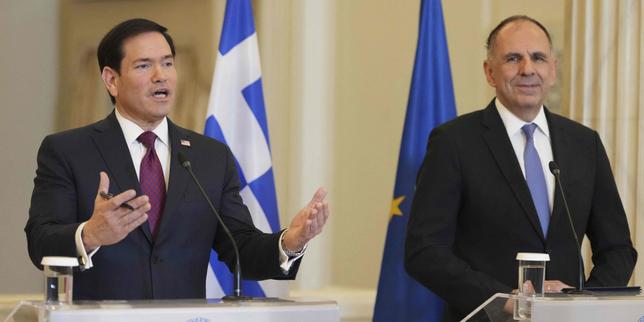
Athens is turning into Washington's most crucial checkpoint in the Mediterranean. If you've been watching how energy corridors and military lines intersect in Southern Europe, you already know that the map is being redrawn. US Secretary of State Marco Rubio’s recent trip to Athens wasn't just a routine diplomatic stop. It marked a heavy acceleration in what officials call an unprecedented security and energy alignment between the United States and Greece.
Forget standard diplomatic pleasantries. Washington wants a reliable anchor in a region plagued by chronic volatility, and Athens is stepping up to take the paycheck and the responsibility.
The Energy Corridor Shift
For years, Europe relied heavily on Russian pipelines, a vulnerability that painfully unraveled when geopolitical friction turned the gas taps into weapons. Greece stepped right into that vacuum. Through projects like the Alexandroupolis floating storage and regasification unit (FSRU), American liquefied natural gas (LNG) enters Europe through Greek ports, bypassing traditional bottlenecks and feeding directly into the Balkans and Eastern Europe.
This isn't just about moving gas molecules. It's about rewriting the economic weight of the Eastern Mediterranean. The recent launch of collaborative energy initiatives—connecting US technical expertise with regional hubs—proves that American capital and Greek geography are locked in a long-term marriage.
Greece isn't just a transit route anymore. It's an energy gatekeeper.
Military Modernization Meets Geopolitics
Energy infrastructure doesn't protect itself. Washington and Athens know that power flows through secure pipelines and heavily defended airspace. That explains the massive upgrades happening across Greek military installations.
We are watching the modernization of Greek F-16 fleets into the advanced Viper configuration alongside active groundwork for acquiring fifth-generation F-35 fighter jets. These aren't cheap toys. They are high-end assets designed to project stability across a fractured neighborhood where maritime disputes and regional flare-ups happen daily.
When Marco Rubio stood in Athens and called out Europe for occasionally stalling on security matters, he made an exception for Greece, praising its frontline role against regional threats. Washington trusts Athens because Athens delivers concrete infrastructure and strategic compliance.
The Pushback on the Ground
Of course, alignment of this scale doesn't happen quietly. Walk down certain streets in Athens today, and you'll run straight into demonstrations. Protesters carrying Palestinian and Cuban flags regularly rally against what they view as a dangerous militarization of their country by foreign superpowers.
Critics argue that binding Greek national security so tightly to Washington's foreign policy chariot turns the country into a permanent target. There's also friction over overlapping maritime borders and offshore exploration rights in the Eastern Mediterranean, where Turkey watches every drillship with intense suspicion.
Athens is walking a tightrope. It wants the economic boom and security umbrella that come with American backing, but it also has to manage complex neighborhood politics that won't disappear just because a contract gets signed in Houston or Washington.
What Comes Next for the Alliance
The US-Greece partnership is moving faster than most EU capitals can comfortably process. Energy independence and military deterrence are the twin pillars keeping this alliance glued together.
Expect more capital to flow into Greek LNG logistics, deeper joint military drills, and continuous diplomatic friction with regional rivals who feel boxed out of the new Mediterranean equation. If you want to understand where European energy security is heading over the next decade, stop looking at Berlin or Paris. Keep your eyes on the ports of Alexandroupolis and Piraeus.
Look at the signed agreements, track the maritime exploration blocks opening up in the Ionian Sea, and watch how quickly those defense contracts materialize. The blueprint is already written.