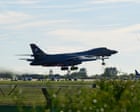
Military logistics rarely change overnight without a very loud alarm sounding behind closed doors. When the United States abruptly flew its strategic bombers out of Gloucestershire, aviation watchers and defense analysts immediately started asking uncomfortable questions. Ten B-1 bombers used in operations connected to the Iran conflict packed up and left RAF Fairford on a Sunday. This wasn't a standard rotation. It was an urgent evacuation driven by security realities that the Pentagon couldn't ignore.
Security at major allied airbases is supposed to be ironclad. Yet, recent events in the UK proved that vulnerabilities exist right under the nose of coalition partners. Days before the mass departure, local law enforcement arrested five men traveling in three separate vans near the perimeter of the military facility. A sixth British-Iranian national was detained soon after. Intelligence pointed toward a planned, targeted attack on the base itself. When potential threats shift from abstract warnings to vans parked near sensitive perimeters, military commanders throw out the rulebook and pivot to self-preservation.
The immediate fallout exposed deep friction between Washington and London over legal procedures. Local authorities chose to release the suspects on bail while investigations continued. The Pentagon reacted with open frustration. American military leadership views active threats against strategic assets through a zero-tolerance lens. Keeping high-value hardware like B-1 bombers parked on an exposed runway while local courts handle suspects with kid gloves is a risk commanders refuse to take.
RAF Fairford has long served as a vital European staging post for long-range US air power. Its strategic position allows the coalition to project force across Europe, the Middle East, and beyond without constantly relying on mainland US refueling paths. Losing its active operational status, even temporarily, throws a wrench into strategic deployment timelines. Planners now have to weigh the convenience of British infrastructure against the raw security liabilities exposed by these arrests.
Intelligence sharing and domestic policing laws often clash when foreign military bases operate on sovereign British soil. The UK operates under strict legal thresholds for holding suspects without formal charges. The US military, operating under wartime or heightened conflict postures, expects immediate preventative detention. This philosophical divide creates dangerous gaps. If a foreign power bases its multi-billion-dollar offensive capabilities in a host nation, the baseline security agreements must evolve to match modern asymmetrical threats.
The abrupt relocation of these aircraft sends a clear signal to adversaries watching from afar. It shows that operational security flaws will trigger an immediate withdrawal rather than a wait-and-see gamble. At the same time, it places immense pressure on UK security services to tighten perimeters and demonstrate that British soil remains a safe staging ground for allied air power.
Expect a quiet overhaul of base security protocols over the coming months. Joint patrols will increase, perimeter surveillance will get tighter, and diplomatic pressure will mount to ensure that future threats are handled with harsher preventative measures. For now, the empty tarmac at Fairford serves as a stark reminder that modern base defense requires far more than high fences and routine patrols.



