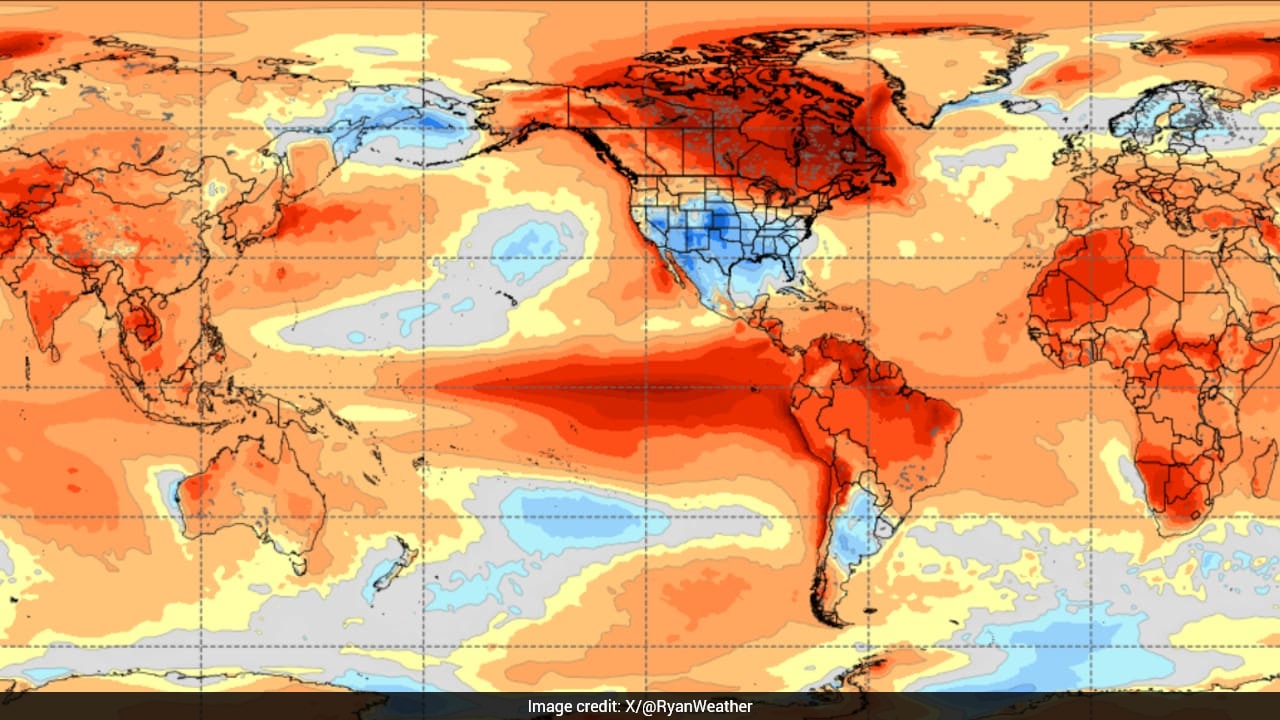
Look at a global temperature anomaly map right now. You won't find many cool blues or neutral greens. Instead, you see a planet painted almost entirely in deep, alarming shades of crimson and red. Meteorologists are watching in real-time as an exceptionally powerful climate cycle takes hold. Some specialists have taken to calling it a "super-duper El Nino," and honestly, the moniker fits.
We are staring down ocean and atmospheric anomalies that push far past historical norms. The World Meteorological Organization (WMO) has issued stark warnings, indicating that this specific event ranks among the strongest observed since record-keeping began in 1950. Sea surface temperatures in the central and eastern tropical Pacific are projected to surge roughly 3.7 degrees Celsius above normal averages between October and December. That is not just a statistical blip. That is a massive injection of thermal energy straight into Earth's climate system.
The Pacific Heat Engine Goes Into Overdrive
El Nino operates on a natural cycle, shifting back and forth every two to seven years. Warm water builds up in the Pacific, alters wind patterns, and sends shockwaves through jet streams worldwide. But this time, the scale is different.
Scientists tracking the Niño 3.4 region report anomalies hitting unprecedented heights, shattering records set during previous major events. When researchers like Ryan Maue point out that planetary heating is dialed up across almost every corner of the globe, they aren't exaggerating. The oceans are holding an extraordinary amount of heat, and they are venting it directly into the atmosphere. For another perspective on this development, see the recent coverage from The New York Times.
Why does this matter to you? Because weather systems don't care about borders. When the Pacific acts like a broken furnace, the consequences ripple outward. You get severe droughts starving agricultural belts of essential moisture, while sudden, torrential downpours trigger flash floods elsewhere. Water scarcity, erratic crop yields, and spiking food prices are the direct downstream effects of these shifting ocean dynamics.
Uncharted Waters and Human Toll
It's easy to look at climate reports as abstract data sets, but the real-world impact carries a heavy human price. Studies from groups like the University of Chicago’s Climate Impact Lab paint a sobering picture. Extreme heat waves fueled by intense climate patterns correlate directly with public health crises. Researchers project hundreds of thousands of excess deaths globally through early next year as vulnerable populations struggle to cope with sustained, oppressive temperatures.
Infrastructure takes a beating too. Agricultural sectors face immediate threats. Farmers from Maharashtra to the American Midwest have to rethink water management overnight as reservoirs shrink and local governments mandate strict rationing. If you rely on stable crop supplies or stable utility grids, you're going to feel the pinch.
What You Can Actually Do About It
You can't control ocean temperatures. You can't turn down the dial on the Pacific Ocean. But you can stop treating extreme weather events as distant news stories that won't touch your daily life.
Start by auditing your household's resilience. If you live in a region prone to drought or extreme heat waves, look into local water conservation tools, backup cooling plans, and community emergency networks. Pay attention to how regional utility providers handle grid stress during peak demand days.
At a broader level, staying informed means looking past short-term weather forecasts and understanding long-term climate trends. When grocery bills climb or insurance rates spike because of agricultural losses, you'll understand the underlying engine driving those changes. Stop waiting for the system to correct itself. Prepare your household for volatility now, because the planet's thermostat isn't cooling down anytime soon.