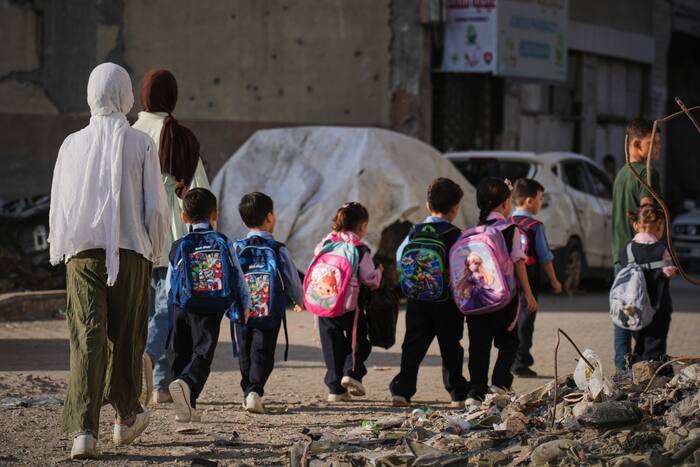
When a U.S.-based charity decided to rebuild schools in war-torn Gaza, its stated goal was simple: provide meals, basic medical care, and a modified curriculum designed to promote peace. But a single operational choice upended that goodwill. The organization plans to install recording equipment and use artificial intelligence to monitor classroom speech for what it labels as "hateful" or "inciting" language.
Instantly, a humanitarian project transformed into a fierce debate over surveillance, autonomy, and the psychological scars of modern warfare.
Let's look at what is actually happening behind the scenes, why local educators and advocacy groups are pushing back hard, and why automated speech policing in a war zone is a massive miscalculation.
The Setup Behind the Academies of Hope
The Gaza Children Village runs schools known as Academies of Hope in central and southern Gaza. The organization was founded by Dr. David Hasan, a Kuwait-born Palestinian-American neurosurgeon teaching at Duke University. After volunteering in Gaza hospitals during the conflict, Hasan wanted to address generational hatred by reshaping educational content.
Hasan relies primarily on private donations—including contributions from American Jews—alongside partnerships with North American, Israeli, and European organizations. His schools lean on the standard Palestinian Authority curriculum, but with a catch. Material that the charity considers inflammatory, antisemitic, or glorifying to violence has been edited out.
To ensure teachers stick to these modified guidelines, Hasan revealed during a recent webinar that classroom conversations will be recorded. An AI-powered system will flag any language deemed problematic, storing audio clips for 72 hours and sending automated alerts directly to him for review.
Why Classroom AI Surveillance Sparks Intense Fear
It is hard to overstate how sensitive surveillance technology is in Gaza right now. Years of high-intensity conflict involving advanced military intelligence gathering have left the local population deeply traumatized by electronic monitoring.
As Amjad Iraqi of the International Crisis Group points out, information warfare has reached a dystopian level. Palestinians live with the constant anxiety that every typed message, spoken word, or casual gesture can be harvested and weaponized against them. Introducing automated acoustic monitoring into a school environment—a space that should feel safe for children and educators—feels like a profound violation.
Even members of the charity's own internal network have expressed alarm. Bishara Bahbah, a Palestinian-American political activist on the charity's board, admitted he was completely unaware of the AI monitoring plans until recently. He noted that while performance observation is normal, recording classrooms to police live dialogue strips away the organic trust required for teaching.
An official with a partner aid organization went a step further, warning that automated speech flags open a dangerous "Pandora's box" that could force humanitarian groups to rethink their associations with the project.
The Core Conflict Over Postwar Education Control
The controversy goes far deeper than algorithms and microphones. It touches on a fundamental question: Who gets to decide what Palestinian children learn?
Critics argue that external charities altering curricula without local accountability strip Palestinians of their educational sovereignty. Ines Abdel Razek, co-director of the Palestine Institute for Public Diplomacy, notes that these efforts amount to external actors attempting to control the psychological landscape of a new generation.
Official representatives from the Palestinian Authority have similarly called classroom surveillance a dangerous line to cross. Even though agencies like UNRWA have faced immense pressure to sanitize textbooks of biased or inflammatory content, doing so via opaque foreign algorithms managed by a single charity executive in North America is a different beast entirely.
Teachers on the ground are caught in an impossible crossfire. Some fear running afoul of local authorities if they work with an organization tied to Israeli aid networks. Others are simply terrified of losing their jobs or facing retaliation if the AI misinterprets a historical lesson, a rhetorical question, or a heated classroom debate as hate speech.
The Flaws of Automated Speech Moderation
Let's be realistic about what AI language models can and cannot do. Even the most advanced audio analysis tools struggle with nuance, context, sarcasm, and regional dialects.
In a multilingual, emotionally charged classroom environment where children and teachers are processing profound personal loss, an automated system looking for keywords is bound to generate false positives. A teacher discussing geopolitical history or quoting historical literature could easily trigger an alert.
When the penalty for a false flag is a direct call from a North American CEO questioning a teacher's intent, the chilling effect is immediate. Teachers will stop engaging in difficult discussions altogether. Instead of fostering critical thinking and peace, classrooms become rigid environments governed by fear of a digital censor.
If humanitarian organizations want to rebuild education in conflict zones, transparency and local buy-in are non-negotiable. Imposing high-tech surveillance tools from thousands of miles away doesn't foster peace. It breeds resentment, distrust, and deeper division.