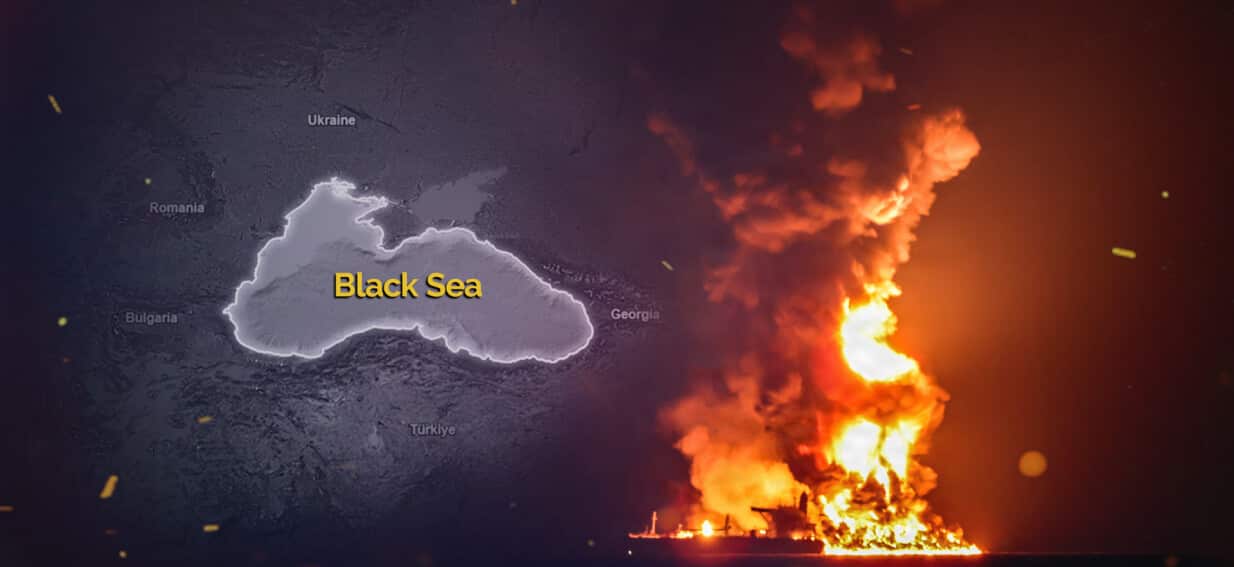
The Black Sea isn't just a regional shipping lane anymore. It has turned into Europe's most volatile flashpoint.
Recent weeks have brought a brutal escalation to the maritime conflict between Russia and Ukraine. Multiple commercial vessels have been struck by drones, leaving ships sunk, cargo on fire, and dozens of crew members missing. If you've been watching the war from a distance, assuming it's confined to eastern Ukrainian trenches, these latest drone strikes off the coasts of Romania and Bulgaria demand a total rethink.
The battlefield has expanded westward. And it's creeping dangerously close to NATO territory.
What Actually Happened on the Water
Let's look at the hard facts. Earlier this week, a Turkish cargo ship loaded with Ukrainian corn caught fire and sank just outside Romanian territorial waters. Two people lost their lives. Romanian officials pointed the finger at aerial and sea drones, though they haven't formally pinned the blame on a specific culprit yet.
Shortly after that tragedy, two more commercial ships were hit by drones roughly 130 kilometres off the coast of Bulgaria. One vessel suffered heavy damage while the other sank completely. Bulgarian maritime authorities confirmed that at least 12 crew members from the sunken ship vanished without a trace.
Bulgarian Prime Minister Rumen Radev pointed out the obvious logistical direction of the attacks, noting that the results favor Russian strategic goals. Meanwhile, the Russian Embassy in Bulgaria flatly denied any involvement. Ukrainian President Volodymyr Zelenskyy blamed Moscow directly, accusing the Kremlin of trying to render the western Black Sea entirely unnavigable.
To add fuel to the fire, the Russian transport ministry claimed an oil tanker in the eastern Black Sea near Sochi was targeted by unmanned Ukrainian naval vessels. Kyiv hasn't explicitly owned up to that specific strike, but Zelenskyy has openly talked about launching a direct response in the Black Sea.
Economic Warfare and Desperation
Why are civilian commercial vessels suddenly caught in the crosshairs? Retired Australian Army major general Mick Ryan recently told reporters that the escalation forms part of a deliberate Russian campaign to economically strangle Ukraine.
Putin's forces are feeling the squeeze. The invasion has dragged on far longer than Moscow anticipated, costing massive casualties with very little strategic payoff. Attacking agricultural exports like corn—vital for global food security—isn't just a military tactic. It's economic warfare designed to break Ukrainian sovereignty from the outside in.
On the flip side, Ukraine has aggressively targeted Russia's shadow fleet. These are sanctioned vessels used to bypass international restrictions on Russian oil and gas exports. Experts like maritime security analyst Jennifer Parker emphasize a crucial distinction: grain ships feeding hungry nations carry no moral or intellectual equivalence to illegal oil tankers funding a war machine.
Yet, Russia's willingness to strike vessels further west in the exclusive economic zones of NATO member states like Romania and Bulgaria signals a brazen shift in tactics.
The Broader Threat to NATO
When attacks happen inside the exclusive economic zones of NATO nations, alarm bells ring across Europe. While these strikes occurred just outside territorial waters, maritime security firms note an undeniable geographic expansion.
European Union foreign policy chief Kaja Kallas recently warned of a sharp spike in hybrid attacks, airspace violations, and sabotage attempts across the continent. From drones crossing into Moldova to mysterious incidents near German airports, the pattern is hard to ignore.
Putin has repeatedly behaved as though Russia is locked in a direct conflict with Western alliances. If NATO continues with a mild or hesitant response, expect these maritime provocations to persist.
Keep a close eye on maritime insurance rates and naval patrols in the western Black Sea over the coming weeks. The ripple effects of these sinking ships will hit global grain markets and push European defense policy into uncharted territory.