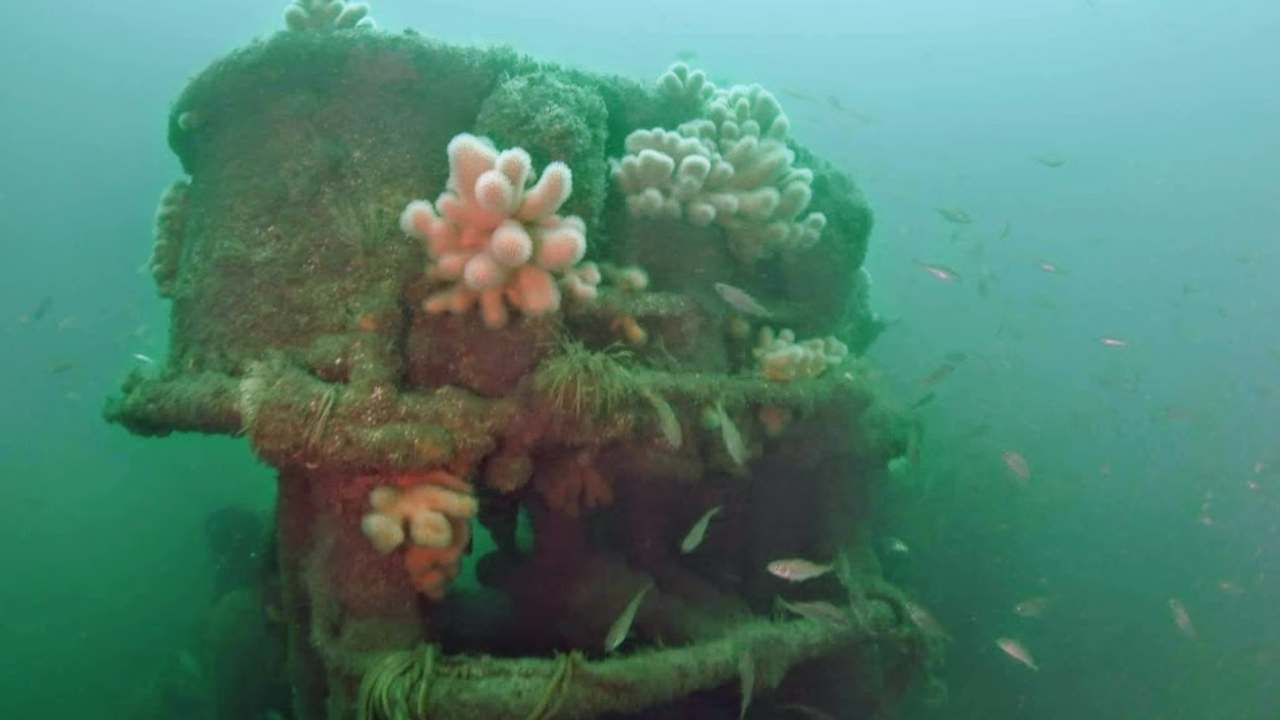
Twelve years ago, an intercepted vessel carrying thirty-two million illegal cigarettes sat tied up at Dublin Port as a massive financial and legal headache. Today, that exact same ship rests ninety-eight feet beneath the surface in Killala Bay, operating as a bustling marine apartment complex.
The story of the MV Shingle is a fascinating look at how human error and bureaucratic gridlock can accidentally pave the way for ecological renewal. Most people assume that marine debris is purely destructive, but intentional artificial reefs turn industrial waste into biological goldmines. If you look at how coastal ecosystems recover when given hard surfaces to cling to, you realize that nature is remarkably efficient at reclaiming metal and wood.
The Cost Of Doing Nothing
When Irish authorities seized the Moldovan-registered vessel back in 2014, they didn't envision a conservation project. They wanted to sell it.
Reality hit hard. The ship was packed with rust and hazardous asbestos. Scrapping it safely turned out to be too expensive, so it languished at Dublin Port for nearly nine years. Berthing fees and required remedial work ballooned past two million euros. Port authorities faced an impossible choice: keep paying to store a toxic metal ghost or find a functional exit strategy.
Instead of letting it rot indefinitely at the dock, officials chose a radical path. In 2024, engineers stripped the MV Shingle of harmful pollutants, hauled it out to sea, and deliberately scuttled it roughly two and a half miles off Ireland's northwest coast.
How The Ocean Claims A Wreck
Nature wastes no time. Within two years of resting on the sandy seabed, the shipwreck has transformed into a thriving habitat.
Marine ecologist Dr Jose Maria Fariñas-Franco from Atlantic Technological University notes that hard surfaces act as premium real estate in open water. Free-floating larvae and spores need a solid anchor point to begin growing. Without rocks or reefs nearby, flat seabeds can be biological deserts. Drop a hundred-foot steel hull into that environment, and the ecosystem responds instantly.
Barnacles and worms are the pioneer species. They lock onto the metal first, followed quickly by filter feeders like sea squirts and sponges.
These early arrivals change the game completely. As small organisms blanket the hull, they create a reliable food source for crabs, lobsters, and fish. Councillor Michael Loftus of the Killala Bay Ships to Reef Group points out that local fish populations have surged around the wreck. Even larger marine mammals like porpoises and dolphins now patrol the surrounding waters, drawn by the sudden spike in prey availability.
The Economics Of Artificial Reefs
Sinking ships isn't just about helping fish; it changes local tourism patterns completely.
Coastal towns usually live and die by summer weather. When July and September end, tourist numbers drop off a cliff. But a vibrant deep-water wreck acts as a year-round magnet for recreational scuba divers and underwater photographers.
In Killala Bay, the sunken cigarette carrier now brings in roughly twelve thousand visitors annually. Divers brave the chilly North Atlantic waters to explore the 197-foot frame, swimming past decks now coated in marine growth instead of illegal cargo.
It proves that smart environmental interventions can pay for themselves. Instead of paying endless maintenance fees at the dock, the port authority turned a liability into an eco-tourism asset.
What Planners Get Wrong About Marine Recovery
Not every old barge or confiscated freighter belongs at the bottom of the ocean. Critics often worry that dumping ships is just an excuse to bypass proper recycling laws disguised as green initiatives.
Dr Fariñas-Franco emphasizes that scuttling vessels only works if strict cleaning protocols are followed first. If asbestos, heavy metals, and toxic paints aren't completely removed, an artificial reef quickly becomes an environmental hazard.
Furthermore, a sunken ship never truly mimics a natural rocky reef. The materials, angles, and chemical composition differ significantly. But in areas lacking natural shelter, steel hulls bridge the gap. They provide immediate vertical relief and surface area that loose sediment simply cannot offer.
If you are looking at coastal management strategies, the lesson is clear. Rigid bureaucratic approaches waste money on dead assets, while bold, calculated ecological risks can spark unexpected biological booms.
Check local maritime authority guidelines if you plan to dive the Killala Bay site, and always verify current sea conditions before heading out on the water.