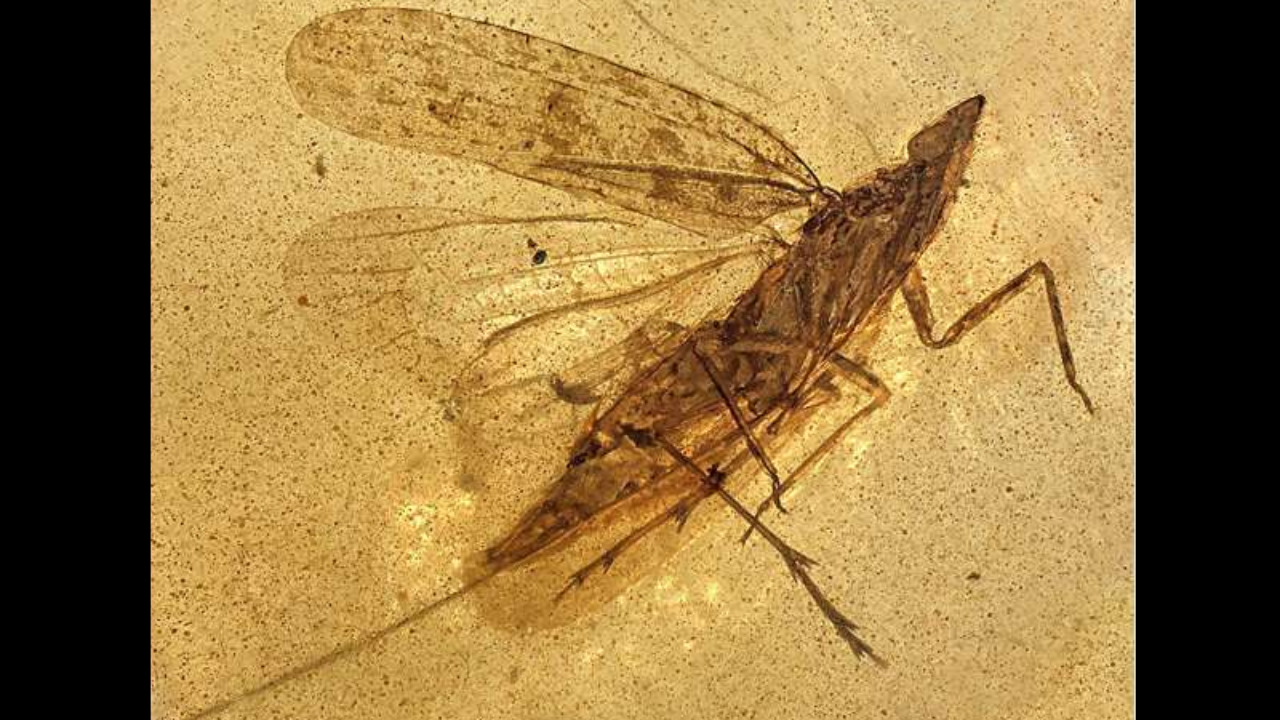
You stumble upon a glob of hardened tree resin, and trapped inside is a tiny frozen secret from the age of dinosaurs. Sounds like science fiction, right? It's not. Researchers examining thirteen specific insect fossils trapped in 99-million-year-old Kachin amber have identified an entirely new species. Meet Cretodorus noonoo, affectionately nicknamed "Noo-Noo."
This extinct planthopper possessed an extraordinary physical adaptation that completely defies modern insect biology. Its mouthpart reached nearly twice its entire body length. Evolution is weird, but this discovery pushes past normal limits. Let's look at why this ancient bug matters and what it tells us about prehistoric forests.
The Mystery of the Noo-Noo Mouthpart
Most modern planthoppers have rigid, needle-like mouthparts. They pierce plant tissue and sip fluids. Simple enough. But Cretodorus noonoo played by an entirely different rulebook.
When scientists from the School of Zoology and The Steinhardt Museum of Natural History analyzed the thirteen amber specimens, they spotted something bizarre. The elongated mouthparts were covered in transverse folds. Using high-resolution micro-computed tomography, the team scanned the internal structures.
Those folds weren't just decorative. They served a mechanical purpose. Much like a corrugated flexible hose or a bendy drinking straw, the corrugations provided extreme flexibility while keeping the tube from kinking or collapsing. Some of the amber fossils even caught these mouthparts frozen in mid-bend.
Think about that for a second. Nature invented corrugated flexible tubing tens of millions of years before humans patented it for plumbing or drinking cups.
Probing Deep Into Prehistoric Bark
Why evolve a flexible feeding straw twice the length of your own body? The answer probably comes down to survival and real estate.
Modern planthoppers don't deal with deep, rugged tree bark the way ancient insects might have. The researchers believe Noo-Noo specialized in tapping tree sap from places ordinary insects couldn't reach. That ultra-long, flexible proboscis could snake through narrow cracks in tough tree bark, dodging obstacles to hit rich vascular tissues below.
At the very tip of this remarkable organ, scientists found another strange feature: a structure with two grooved lobes. During feeding, these lobes likely opened up. They acted like a mechanical wall anchor, expanding inside a drilled hole to keep the mouthpart steady against the pressure of the tree's sap flow. It's a specialized drilling and anchoring system built into a bug smaller than your fingernail.
What Cretodorus Noonoo Tells Us About Cretaceous Forests
Discovering a new species is always exciting, but the broader ecological picture is where things get genuinely fascinating. Long, corrugated feeding structures popped up in several completely unrelated insect groups during the Cretaceous period.
Why did this happen independently across different lineages? The answer points straight to the environment.
Cretaceous forests produced massive amounts of resin, and they burned frequently. Recurrent wildfires mean one thing for trees: thick bark. Trees evolve heavy, insulating bark to survive fires. In turn, that thick bark created a brand new ecological niche. Insects that figured out how to pierce deep through protective bark layers unlocked a food source closed off to everyone else.
Dr. Leonidas-Romanos Davranoglou, one of the study authors, noted that these finds give us an extraordinary glimpse into dinosaur-era ecosystems. Ancient forests created pressures and opportunities that simply don't exist in modern nature.
Why Modern Planthoppers Don't Do This
If this design was so successful, where did it go? Evolution doesn't have sentimentality. When environments shift, specialized traits often become evolutionary dead ends.
As climate patterns changed, the specific kinds of fire-prone forests and thick-barked trees declined or evolved. Modern planthoppers adapted to different plants, grasses, and leaves where a bendy, double-length face straw is a liability rather than an asset. Noo-Noo's unique solution vanished from the planet, preserved only because a drop of sticky tree sap happened to trap 13 unlucky insects nearly 100 million years ago.
Next time you look at a piece of amber jewelry, remember what might be hiding inside. It's not just a pretty stone. It's a window into a lost world where insects packed biological engineering marvels we are only just beginning to understand.