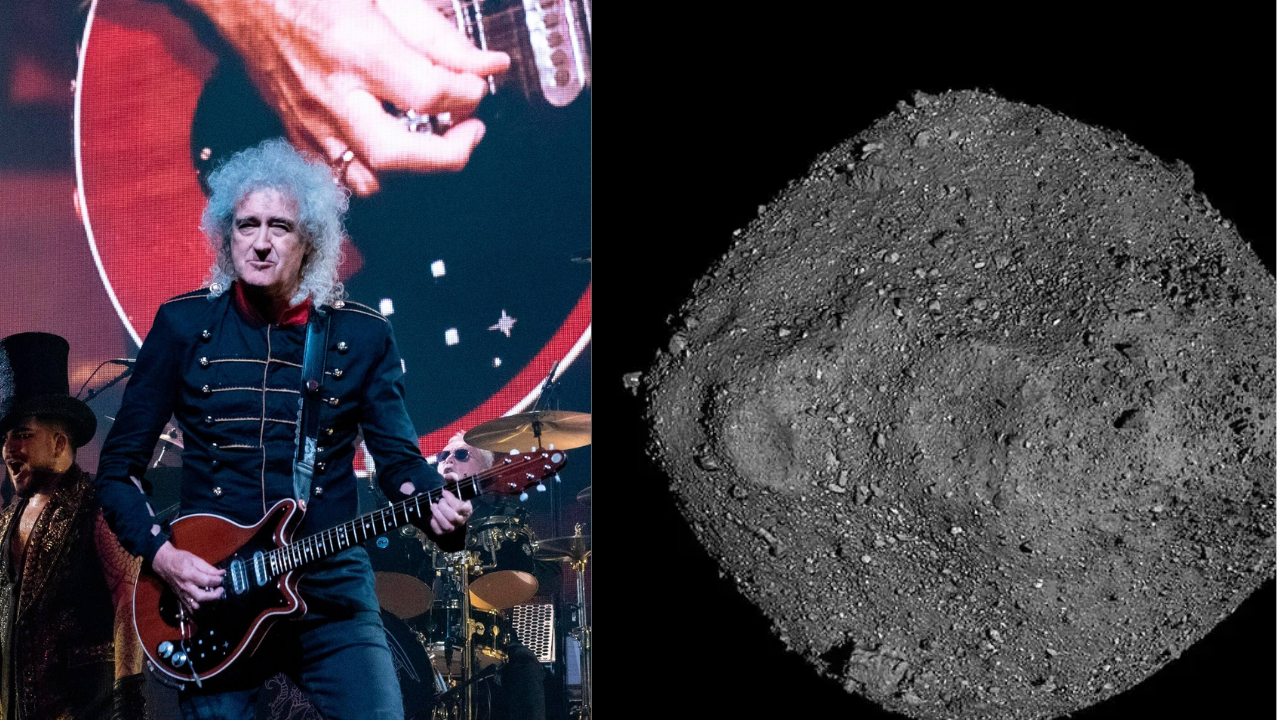
Landing a spacecraft on a 500-meter-wide space rock sounds straightforward on paper. You look at flat maps, pick a spot, and touch down. Reality rarely cares about mission blueprints. When NASA's OSIRIS-REx spacecraft arrived at asteroid Bennu, planners found a surface completely choked with boulders, jagged rocks, and steep craters. The smooth landing zones engineers expected simply did not exist.
NASA needed an urgent fix to visualize the treacherous terrain. Surprisingly, the solution came from Queen guitarist and astrophysicist Brian May. His stereoscopic imaging expertise transformed flat spacecraft photos into three-dimensional views, helping save a multi-million-dollar planetary mission.
The Stereo Vision That Saved OSIRIS-REx
Brian May joined the OSIRIS-REx science team in January 2019. He brought decades of experience in stereoscopic photography—a technique that creates depth perception by combining two images captured from slightly different angles. OSIRIS-REx lacked a dedicated stereo camera, meaning standard single-camera frames had to suffice.
May worked alongside planetary scientist Claudia Manzoni. They poured over incoming photographs, identifying image pairs taken at varying viewpoints. By carefully aligning them, they gave the mission team clear spatial awareness of height, depth, and relative obstacle placement. Without this visual depth, engineers had no reliable way to judge boulder heights or crater depths from standard two-dimensional telemetry.
Picking a Landing Spot on a Boulder Trap
NASA originally designed the sampling maneuver around a smooth target area roughly 25 meters across. Bennu mocked that requirement. The surface was a chaotic rubble pile, leaving tiny potential pockets where a spacecraft could squeeze down.
The search ultimately narrowed to two candidate sites named Osprey and Nightingale. Osprey measured just six meters across, while Nightingale was roughly eight meters wide. Osprey appealed to engineers because its rim lacked dangerous boulders. Nightingale attracted scientists because its dark, ancient regolith promised pristine material preserved from the early solar system.
The team chose Nightingale. That choice required threading the probe past a massive boulder perched right on the crater edge. May's three-dimensional visualizations gave engineers the confidence to map a descent path through those tight hazards.
When an Asteroid Acts Like Liquid
OSIRIS-REx finally executed its touch-and-go maneuver at Nightingale in October 2020. Contact with the surface produced a massive surprise.
Scientists anticipated a firm gravel layer that would absorb the probe's impact. Instead, the spacecraft sank deep into the regolith. Video feeds showed a cloud of loose debris shifting violently around the sampling head. Bennu behaved less like solid rock and more like a fluid pool of gravel. The spacecraft could easily have tipped over or become trapped if its thrusters hadn't fired to push it back into orbit immediately.
Bennu is a rubble-pile asteroid—a collection of space debris held together loosely by gravity rather than solid rock. This structure explains why touching the surface caused such an unexpected avalanche.
Bringing Bennu Home
Despite the treacherous terrain and fluid surface behavior, the mission succeeded. OSIRIS-REx departed Bennu in May 2021 carrying more than the minimum collection target of 60 grams. The sample capsule parachuted down into the Utah desert in September 2023, delivering pristine material for laboratory analysis.
Studying this material helps scientists understand early solar system formation and improves planetary defense models. Bennu carries a tiny statistical chance of impacting Earth centuries from now, making accurate data on its physical structure critical.
May and mission principal investigator Dante Lauretta later documented this visual mapping feat in their book, Bennu 3-D: Anatomy of an Asteroid. The project proved that unconventional expertise can solve modern space exploration crises. Stop relying solely on automated algorithms when human ingenuity and historical photographic techniques can reveal the true shape of the cosmos.